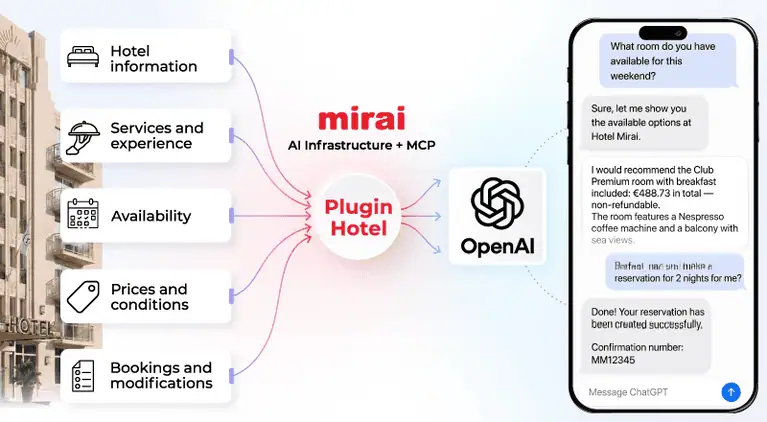
Mirai is deploying hotel plugins that allow guests to access hotel information and booking functions through ChatGPT.
Pablo Delgado, Managing Partner & CEO America at Mirai, oversees the company’s work in the Americas as it develops this approach to AI-powered hotel distribution.
The company said users can now interact with Hotel Emperador and Hotel Moderno in Madrid, Porcel Hoteles in Granada, and Gloria Thalasso & Hotels in the Canary Islands through ChatGPT. The plugins allow users to check information and make bookings using natural language.
Originally called Apps by ChatGPT, OpenAI recently updated the terminology and structure of its ecosystem, transforming the App Directory into the Plugin Directory. Although the industry still commonly refers to them as Apps, Mirai uses the term plugins in this context.
A plugin connects ChatGPT with an external service. It can retrieve information, access tools and carry out actions on a user’s behalf. For hotels, this can allow guests to interact with the property directly within ChatGPT rather than leaving the conversation.
The functions can range from answering questions through a hotel’s knowledge base to handling real-time transactions.
Users can check availability and prices for specific dates and occupancy, change currencies, filter results, explore rooms and promotions, make bookings, and modify or cancel existing reservations.
Hotels Prepare for an Agentic Distribution Model
Mirai argues that the growth of AI agents is creating a new distribution environment that will operate alongside the web.
Hotels have spent decades building websites and direct booking channels for people to use. Now, the company says, those same channels must also be accessible to AI agents.
This does not mean the website is disappearing. Instead, the change affects how users interact with hotel technology.
On the web, people search, compare options, browse pages and complete actions themselves. In an agentic environment, they can increasingly delegate those tasks to an assistant acting on their behalf.
That shift has technological implications for hotel direct channels.
For decades, hotels have built websites and booking engines that allow people to discover properties, check availability, compare rooms and rates, and complete bookings.
AI agents require direct access to information and functions that they can understand and use.
For example, knowing whether a hotel allows pets is information. Checking availability for two adults and one child on specific dates is a function.
Likewise, knowing a rate’s conditions is information. Quoting the rate, applying loyalty programme conditions, booking it, and later modifying or cancelling the reservation are functions.
Mirai therefore argues that hotels will need to make both their information and direct booking capabilities accessible to AI agents.
The question is moving beyond how hotels can become discoverable to AI systems. It is also becoming about how their direct channels can operate through those systems.
Within the OpenAI ecosystem, Mirai sees plugins as one way to provide that access.
The Infrastructure Behind the Plugins
Mirai’s work on hotel plugins began before the current ChatGPT integration.
The company has been developing an AI infrastructure that centralises hotel information and allows external systems to access both that information and transactional capabilities in a structured way.
A key part of the architecture is MCP (Model Context Protocol).
On top of this layer, Mirai has been exposing tools that allow users to access hotel information and perform actions through the direct channel. These include searching availability and prices, checking products and conditions, creating bookings, and managing existing reservations.
The approach separates direct-channel capabilities from the interface used to access them.
A hotel website can use those capabilities. So can Mirai’s conversational assistant, Sarai, as well as voice systems and external AI agents.
As a result, when OpenAI introduced the ability to connect ChatGPT with external services through Apps, now integrated into its plugin ecosystem, Mirai said much of the underlying infrastructure was already in place.
The plugin acts as the connection to ChatGPT. The hotel’s information and direct-channel capabilities remain behind it.
How AI Assistants Are Taking Different Paths
The shift is not limited to OpenAI.
Major AI assistants are moving from systems that primarily answer questions toward systems that can also perform actions on a user’s behalf. That requires access to external information and capabilities.
The technology companies are taking different approaches.
OpenAI is building this access around plugins, which package external integrations and capabilities for use within ChatGPT. Mirai said its plugins allow ChatGPT to access capabilities exposed through its MCP-based AI infrastructure.
Anthropic has taken a more direct approach around MCP, allowing Claude to connect to external servers and use the tools they provide.
Google, meanwhile, has moved into travel through agentic hotel booking within AI Mode in Search. Users can discover and compare hotels using natural language and continue the booking process within the Google experience.
The approaches differ, but the underlying objective is similar: connect AI assistants with external information and capabilities so they can move from answering questions to taking action.
Which approach will scale most effectively remains unclear.
Why Hotel Plugins Need More Than Links
Hotel plugins are already available, but Mirai said many currently provide a limited experience.
One limitation is the absence of booking capabilities. Another is the replication of a visual hotel experience inside ChatGPT, with photos, rooms, rates and buttons that ultimately send users back to the hotel website.
Such integrations can provide an initial connection, but Mirai argues that they offer limited additional value compared with using the hotel website directly.
The company’s view is that users should be able to interact with a hotel through natural language without leaving ChatGPT.
A traveller could, for example, say:
“I want to go to Madrid next weekend with my wife and two children. I’m looking for a room with breakfast and I prefer a cancelable rate.”
The assistant could then interpret the request and use the hotel’s direct-channel capabilities. It could check availability and prices, filter relevant options, compare rooms and rates, explain the differences, and complete the booking.
This approach becomes particularly relevant for voice interaction.
A plugin that depends heavily on photos, buttons and other visual elements has limited usefulness when a user is interacting by voice. In that setting, the interface becomes less important. The focus shifts to whether the hotel can understand a natural-language request and respond with the appropriate action.
Mirai also points to a broader shift toward natural language as an interface for digital services, whether users type or speak.
For hotels, the company argues, preparing for this change means making direct-channel capabilities available to assistants rather than simply reproducing the website inside ChatGPT.
A Potential Channel for Repeat Guests
Plugins could also have a role with customers who already know a hotel or hotel chain.
Hotel groups have long used mobile apps to maintain a direct relationship with loyal guests. A plugin could provide another route to that relationship within ChatGPT.
The difference is that guests would not need to learn another interface. Instead, they could use natural language to request what they need.
A repeat guest could view upcoming stays, search for a hotel within a chain, apply loyalty benefits, make a booking or manage an existing reservation through the same assistant used for other tasks.
In this scenario, the plugin would be less about introducing an unknown brand and more about providing another gateway to the hotel’s direct channel.
Early Stage for Hotel AI Plugins
Mirai said its first plugins are being used to test the architecture in real-world situations. However, the company does not expect the current ChatGPT plugin ecosystem to immediately become a significant booking channel for hotels.
The ecosystem remains in an early stage. Distribution, discovery and usage are still developing, while the longer-term structure of the market remains uncertain.
Discovery is one unresolved issue.
It is difficult to imagine travellers installing plugins for hundreds or thousands of individual hotels simply to interact with them. This raises the question of how AI assistants will eventually discover and select appropriate sources of information and capabilities automatically.
Another question is where plugins will fit in the booking journey.
They could primarily operate at the lower end of the funnel, when a traveller already knows what they want and needs to check availability, make a booking or manage an existing reservation.
However, they could also become part of inspiration, discovery and recommendation.
Structured, current and actionable hotel information could potentially make plugins useful at those earlier stages. For now, however, the role they will ultimately play has yet to be established.
Mirai therefore sees the current deployments primarily as an opportunity to test and learn.
The company said it wants to understand how users interact with the technology, which capabilities they use, how much control they are willing to delegate, how discovery develops, and what hotel direct channels will need to compete in an AI-driven environment.
Mirai plans to progressively extend the capability to more clients. For now, deployments will remain limited while the company gathers insights from the initial implementations.
Related Coverage
IHG Brings Hotel Search to ChatGPT as AI Travel Planning Surges
