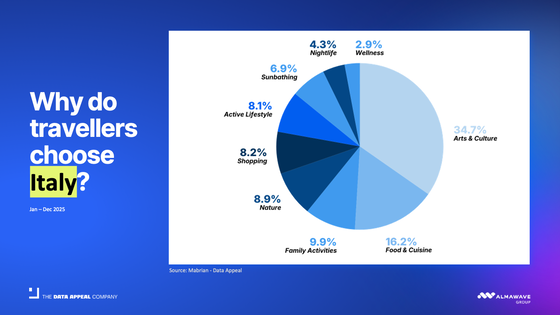
Italy cultural tourism trends 2025 highlight how Italy continues to lead globally in heritage appeal, while shifting traveler behavior is redistributing demand beyond traditional cities and reshaping visitor experience expectations.
Disclosure: This article contains affiliate links. We may earn a commission at no extra cost if readers explore products or services through these links. As an Amazon Associate, we earn from qualifying purchases.
Key Takeaways
- Italy retains the highest number of UNESCO World Heritage Sites globally, totaling 61
- Cultural tourism demand expands beyond Rome and Florence into secondary cities
- Solo travel to Italian art cities increases year-on-year
- Visitor satisfaction increasingly shaped by food, hospitality, and overall experience
- Interactive museum experiences and operational efficiency drive engagement
Italy Maintains Global Cultural Leadership
Italy continues to hold the world’s largest concentration of UNESCO World Heritage Sites, with 61 listings. The addition of Italian cuisine to UNESCO’s intangible heritage list in 2025 further strengthens the country’s position as a global cultural destination.
However, beyond heritage volume, recent data from Data Appeal and Mabrian—both part of Almawave—points to a structural shift in how travelers engage with Italy’s cultural assets.
Between January and December 2025, digital travel behavior indicates a more diversified demand pattern, evolving visitor expectations, and rising importance of experience quality.
Who Is Traveling to Italy’s Art Cities
Italy cultural tourism trends retain a strong social dimension. Couples account for 43% of travelers visiting major art cities, followed by families at 28%.
Solo travel continues to gain traction, representing 16% of visitors and increasing by 3% year-on-year. This growth reflects a broader trend toward independent and personalized cultural exploration.
Group travel accounts for the remaining 12%.
From a source market perspective:
- Domestic travelers remain the largest segment
- France remains stable year-on-year
- Germany declines from 7% to 5.5%, indicating subtle shifts in European travel patterns
Heritage Drives Demand, Experience Drives Satisfaction
While cultural landmarks remain the primary motivation, traveler satisfaction is increasingly influenced by the overall experience.
In 2025:
- “Arts & Culture” accounted for 34.7% of travel motivation
- Culinary experiences scored 86.5/100 (+1.1 YoY)
- Accommodation scored 81.9/100
- Short-term rentals reached 84/100
These findings confirm that Italy’s tourism competitiveness extends beyond heritage to include gastronomy, service quality, and destination atmosphere.
Rome Leads, but Growth Extends Beyond Iconic Landmarks
Rome continues to dominate in visitor volume and landmark visibility.
- Trevi Fountain ranks first with 53.1K reviews (+67% YoY)
- Colosseum follows with 52.4K reviews and strong sentiment (92.5/100)
Meanwhile, Milan’s Duomo di Milano ranks third, achieving one of the highest satisfaction scores (93.7/100).
Other top-performing landmarks include:
- Pantheon
- St. Peter’s Basilica (94.1/100 sentiment)
These results suggest that high visitor volumes do not necessarily reduce satisfaction when operational management remains effective.
Museums and Cultural Institutions Show Strong Engagement
Florence and Rome dominate museum visibility.
Key institutions include:
- Museo Leonardo da Vinci Interattivo (Florence)
- Vatican Museums
- Archaeological Park of Pompeii
Sentiment scores for leading museums exceed 95/100, indicating strong visitor engagement.
Notably, Verona’s Juliet’s House records the highest growth in review volume (+19.1%), highlighting sustained demand for narrative-driven attractions.
Toward a More Balanced Cultural Geography
Although Rome remains dominant, visitor sentiment is rising across secondary destinations.
In Central Italy:
- Siena
- Assisi
In Southern Italy:
- Caserta (85.5/100 sentiment)
- Bari (85/100 sentiment)
The Reggia di Caserta ranks among the most visited museums nationwide, while Naples’s Museo Cappella Sansevero shows strong growth (+10.89%).
According to Federica Amati, Sales Engineer at Data Appeal:
“Cultural demand is no longer concentrated solely in Italy’s traditional art capitals. Secondary cities are strengthening their reputations through authentic experiences.”
Interactivity and Operations Shape Future Demand
Analysis highlights growing demand for immersive and interactive museum experiences. Attractions incorporating participatory elements tend to generate higher engagement and visibility.
However, recurring operational challenges remain:
- Pricing perception
- Cleanliness standards
- Waiting times
Addressing these factors through timed entry systems and improved visitor flow management is increasingly critical to maintaining satisfaction at scale.
Why It Matters
Italy cultural tourism trends 2025 reflect a broader transformation across European travel markets.
While iconic cities like Rome and Florence remain central, demand is dispersing geographically, supporting:
- Reduced overtourism pressure in major hubs
- Economic diversification across secondary cities
- Greater resilience in tourism ecosystems
These patterns align with findings from the European Travel Commission, which indicate long-haul travelers are increasingly seeking less crowded, experience-rich destinations.
For the hospitality sector, this shift presents opportunities to expand investment beyond traditional gateways while aligning with evolving traveler expectations centered on authenticity and experience quality.
At a Glance
- Country: Italy
- Key Focus: Cultural tourism demand and visitor behavior trends (2025)
- Data Sources: Data Appeal, Mabrian
- Timeframe: January–December 2025
- Key Insight: Demand dispersing beyond major art cities
- Strategic Implication: Growth opportunities in secondary and southern destinations
Travel Considerations for Multi-Market Stays
As travelers explore multiple Italian cities like Rome, Florence, and Milan, many consider travel coverage options for international trips, particularly when combining urban and regional destinations.
To manage complex cultural itineraries efficiently, travelers may use travel planning tools to organize multi-destination trips across Italy.
For more curated travel gear and luggage recommendations, explore our recommended travel products designed for efficient city travel.
Also read Best Hotel in Rome (2026) — Live Voting
Editorial disclosure: This article is an independently written editorial analysis based on industry reporting from Insider Travel Report. The content has been rewritten and contextualised for editorial clarity and relevance.
