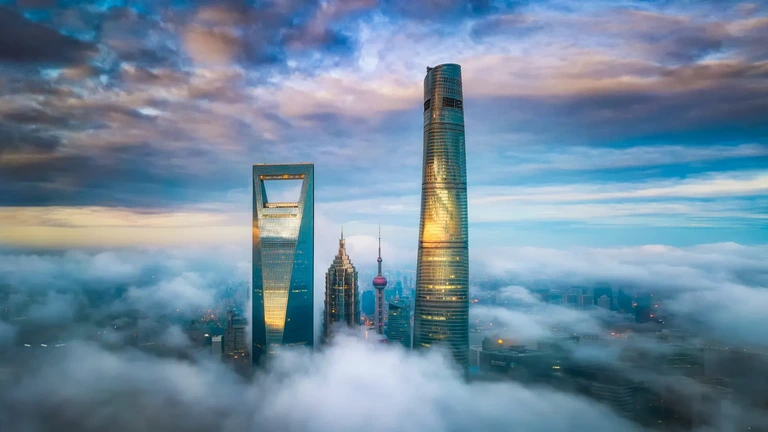
Few hotels in the world are built this high above a city. I stayed at J Hotel Shanghai Tower during its fifth anniversary year, which felt like the perfect moment to revisit one of China’s most talked-about luxury hotels for a full and honest review.
Living in Shanghai means this wasn’t simply a one-off “bucket list” stay. It became more of a “has it aged well?” experience — especially now that Shanghai and wider China inbound tourism are seeing renewed momentum again in 2025–2026.
At the same time, I originally chose the hotel for the experience itself: staying inside Shanghai Tower — currently the world’s third-tallest skyscraper — and seeing how a true ultra-high-rise luxury hotel compares to more traditional skyline properties.
Part leisure, part curiosity, and part content research.
J Hotel Shanghai Tower is also more than just another luxury hotel. Developed by Jin Jiang International as the flagship property of its ultra-luxury J brand, the hotel represents one of China’s most ambitious homegrown hospitality projects, combining Chinese cultural references with global luxury positioning.
Occupying the upper floors of the 632-metre Shanghai Tower — currently the world’s third-tallest building after Burj Khalifa in Dubai and Merdeka 118 in Kuala Lumpur — the hotel immediately operates on a scale few urban luxury properties can match.
That alone makes it one of the world’s most distinctive architectural hotel stays.
With China reopening more strongly to international tourism, the hotel now feels like it is entering a renewed phase of global attention from travelers seeking a very specific kind of luxury experience:
A sky-high Shanghai stay above the clouds.
The Scene — Location & First Impressions
The hotel sits inside Shanghai Tower in Lujiazui, the heart of Shanghai’s futuristic financial skyline.
This is not historic Shanghai.
It’s futuristic Shanghai.
From the room, the city feels layered beneath you:
- The Bund glows across the Huangpu River
- Pudong’s skyscrapers sit almost at eye level
- Traffic patterns look miniature from above
- Cloud lines sometimes drift directly outside the windows
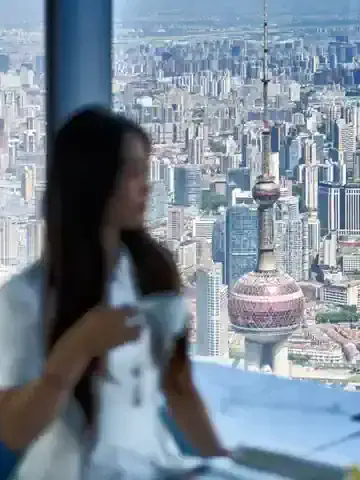
It’s one of the most visually intense hotel settings anywhere in Asia. On lower-cloud days, parts of Pudong occasionally disappear beneath drifting fog, making the hotel feel even more detached from the city below.
Best for:
- Skyline-focused luxury travelers
- First-time Shanghai visitors
- Business travelers staying in Pudong
- Architecture lovers
- Special occasion trips
Less ideal for:
- Boutique hotel lovers
- Travelers seeking traditional lane-house culture
- Guests wanting resort-style relaxation
What is Around The Hotel
| Attraction | Approximate Distance |
| Oriental Pearl Tower | ~0.8 km |
| Shanghai Ocean Aquarium | ~0.9 km |
| The Bund | ~1.5 km |
| Yu Garden | ~1.3 km |
| IFC Mall | Short walk |
| Super Brand Mall | Nearby |
Despite being inside a supertall skyscraper, the hotel is surprisingly practical for getting around Shanghai.
Metro Access
The closest station is:
- Lujiazui Station (Metro Lines 2 and 14)
It’s less than a 10-minute walk from the hotel.
Line 2 is especially useful for travelers, connecting key hubs including:
- Pudong Airport
- Hongqiao Airport
- People’s Square
- Nanjing Road
- Jing’an
- Hongqiao Railway Station
That makes the hotel convenient for both tourism and business travel.
Airport Distance
- Pudong International Airport: ~30 km
- Hongqiao Airport: ~17 km
The hotel’s location is internationally famous because it combines:
- The world’s third-tallest skyscraper
- One of the world’s great urban skylines
Few hotels globally can match this combination of architectural significance, skyline immersion, and central business district positioning.
That is why many travelers treat J Hotel as a destination hotel rather than simply accommodation.
The Hotel — Design, Arrival & Atmosphere
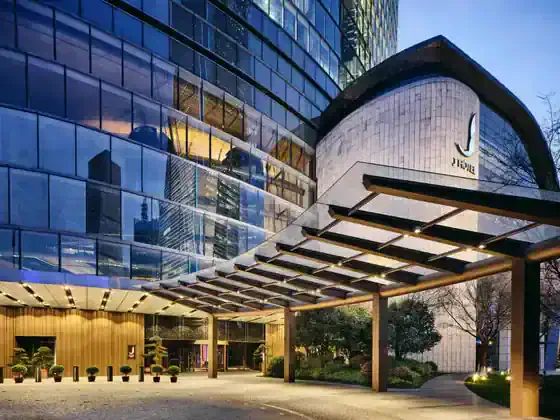
Arrival inside Shanghai Tower already sets the tone.
Traditional Shanghai and Chinese cultural influences appear throughout the property, including references to Shikumen architecture, magnolia motifs, glazed ceramics, and contemporary interpretations of Chinese craftsmanship.
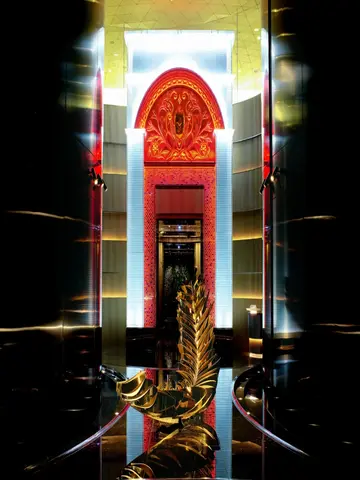
You move through a sequence of high-speed elevators, sky lobbies, and layered vertical transitions before even reaching reception. It feels less like entering a conventional luxury hotel and more like stepping into an architectural experience suspended above the city.
The interiors lean heavily into scale and theatricality without becoming aggressively flashy. Polished marble, crystal installations, lacquer details, metallic artwork, soft lighting, and panoramic skyline framing create an atmosphere that feels intentionally monumental rather than intimate.
Despite the futuristic setting, the hotel makes a noticeable effort to balance modern spectacle with cultural identity.
One of the most striking arrival moments is the sky bridge on Floor 101, where glass, metal, and large-scale art installations reinforce the feeling that the hotel operates in its own world above Shanghai.
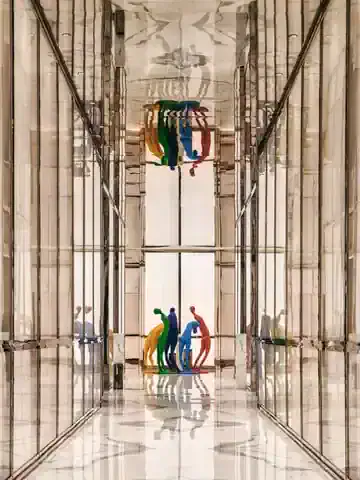
The atmosphere throughout the property is calm, highly curated, and surprisingly quiet for a hotel inside one of Asia’s busiest financial districts.
It doesn’t feel casual.
It feels designed to impress.
Rooms & Suites — Sky Living Above Shanghai
J Hotel Shanghai Tower features 165 rooms and 34 suites spread across floors 86 to 98, ranging from 62 sqm staterooms to the enormous 380 sqm Shanghai Suite.
One unexpected detail was how quiet the rooms felt late at night. Despite being suspended above one of the busiest cities in the world, the hotel often felt strangely detached from the movement below.
The biggest feature is obviously the view.
You’re positioned high enough that Shanghai begins to feel miniaturised below you. At night, the Huangpu River cuts through the city while Pudong’s skyscrapers sit almost at eye level.
Rooms are divided into two main design styles: “New Chinese” and “Contemporary.” They’re not just “hotel rooms,” but sky residences suspended inside a supertall skyscraper.
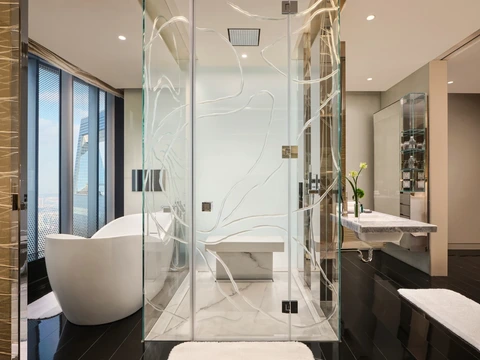
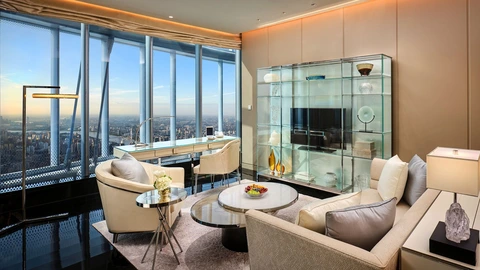
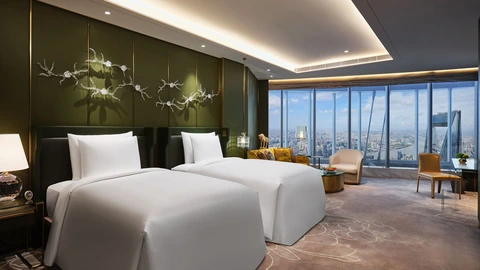
The New Chinese rooms lean more traditional with darker woods, glazed detailing, Jiangnan-inspired references, and richer textures. The Contemporary rooms feel brighter, cleaner, and more modern with crystal accents and lighter palettes.
Even entry-level category Staterooms are typically around 60–75 sqm.
Reality check: They already feel comparable to junior suites in most luxury hotels.
Inside the rooms:
- Floor-to-ceiling skyline windows
- Oversized layouts
- Magnolia-inspired soaking bathtubs beside the windows
- Smart lighting and curtain systems
- Walk-in closets
- Strong sound insulation
- Butler closets for discreet service delivery
- Large workspace areas
One thing the hotel does especially well is spatial separation.
Even standard staterooms feel intentionally divided into living, sleeping, and dressing zones rather than functioning as one large open room.
Room Recommendations
Best value (first stay): Entry skyline room
→ Maximum visual impact without suite pricing
Best romantic stay: Bund-facing room or corner room
→ Strongest sunset and skyline atmosphere
Best business stay: Standard stateroom
→ Quiet, spacious, efficient layout
Best luxury long stay: Suite
→ Separate residential-style living and bedroom areas
Best photography stay: High-floor Bund-view room
→ Best golden-hour and nighttime skyline framing
Key tip: Room orientation matters more than room category.
Some views are partially affected by the tower’s structural exterior layers, so choosing the right facing direction can dramatically change the experience.
For comparison booking, I’d recommend checking room rates across multiple booking platforms like Booking.com, Trip.com, Agoda, Expedia, and Klook because pricing fluctuates heavily depending on weekends, holidays, and skyline-facing availability. Not sure where to start? Compare hotel prices across platforms in our full guide to the best hotel booking sites.
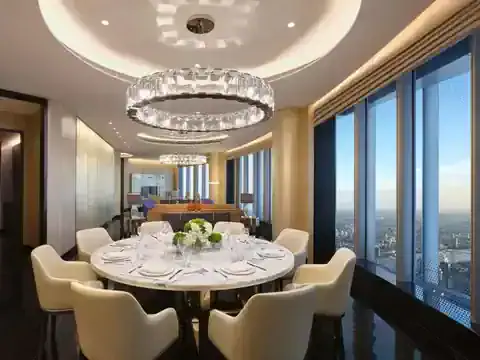
Dining Venues — Vertical Fine Dining Above Shanghai
The hotel has 7 main dining and bar venues, each located on different sky levels inside Shanghai Tower.
They include:
- 4 signature fine-dining restaurants
- 2 lounges / bars
- 1 café & patisserie
Each one is positioned like a “layer in the sky”.
Heavenly Jin (120F)
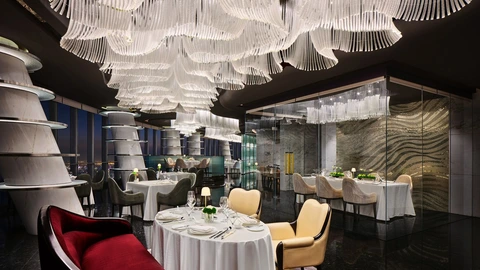
This is the flagship experience of the hotel.
Located approximately 556 metres above ground level, Heavenly Jin is recognised as one of the world’s highest restaurants inside a building.
Dining here feels less like a normal hotel dinner and more like a surreal skyline event suspended above Shanghai.
The restaurant focuses heavily on Huaiyang and Jiangnan cuisine while surrounding guests with mosaic artwork, dramatic lighting, skyline panoramas, and one of the most visually striking dining rooms in China.
At night especially, the combination of elevation, reflections, and city lights becomes almost dreamlike.
Advance reservations are strongly recommended.
Centouno (101F)
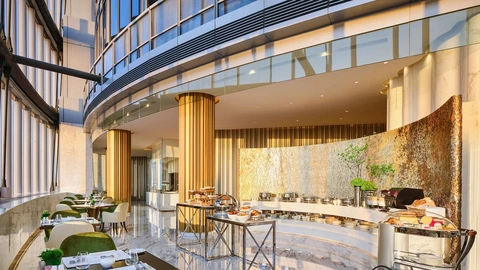
Centouno is the hotel’s more approachable all-day venue, specialising in southern Italian cuisine with a lighter and more relaxed atmosphere than the signature Chinese restaurants.
Open kitchens, handmade pasta, seafood dishes, and skyline-facing seating make it one of the easier venues for casual luxury dining inside the property.
Compared to the rest of the hotel, the energy here feels warmer and less formal.
Kinnjyou Inaka (104F)
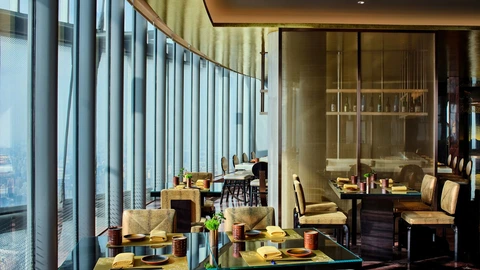
Kinnjyou Inaka focuses on Japanese dining experiences including teppanyaki, kaiseki, sushi, and omakase-style service.
The restaurant becomes especially atmospheric at night, combining infinity-mirror ceiling effects, live cooking counters, and skyline-facing private dining rooms overlooking illuminated Pudong.
It feels highly performance-driven in the best way.
Jin Yan (103F)
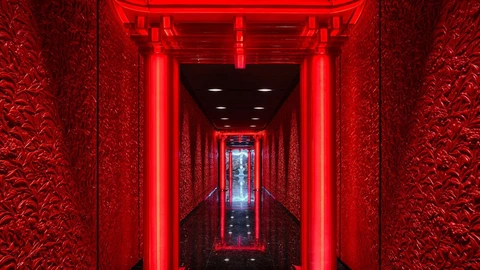
Jin Yan is probably the most traditionally “Chinese luxury” feeling restaurant in the hotel.
Deep red tones, jade-inspired details, glaze artwork, dragon motifs, and private dining rooms themed around the five elements create an environment that feels ceremonial and highly curated.
The focus is Cantonese fine dining, including seafood, roast meats, banquet dishes, and dim sum.
Best suited for:
- Business dining
- Group celebrations
- Formal Chinese dinners
- Luxury entertaining
Lobby Lounge & Yi Lounge (101F & 84F)
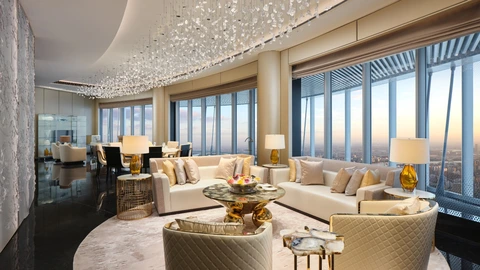
The Lobby Lounge on Floor 101 functions as the hotel’s social space for coffee, afternoon tea, and informal meetings.
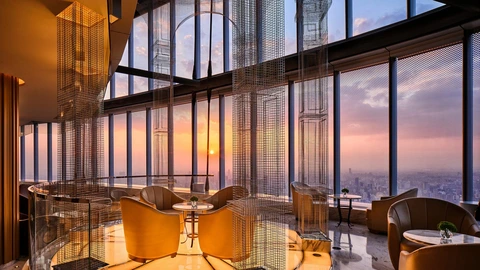
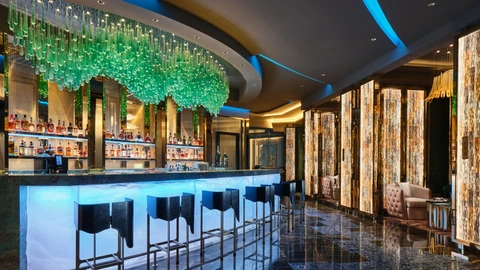
Meanwhile, Yi Lounge on Floor 84 leans more nightlife-oriented with cocktails, skyline views, and live jazz performances overlooking Pudong at night.
Café & Patisserie (1F)
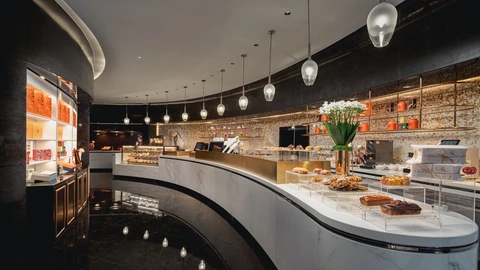
Located closer to the tower entrance, the Café & Patisserie is the hotel’s grab-and-go venue for coffee, pastries, light meals, and quick breakfast options.
Compared to the dramatic sky-level restaurants upstairs, this space feels intentionally simpler and more functional.
Meetings & Events — Skyline Business Venue (105F)
The hotel’s main event spaces are located on the 105th floor, transforming Shanghai’s skyline into part of the venue experience itself.
The standout space is the 422 sqm Soirée Ballroom, this is the hero event space of the hotel, a semi-circular panoramic venue surrounded by floor-to-ceiling skyline views.
Rather than relying purely on decoration, the ballroom uses elevation and the city backdrop itself as part of the event design.
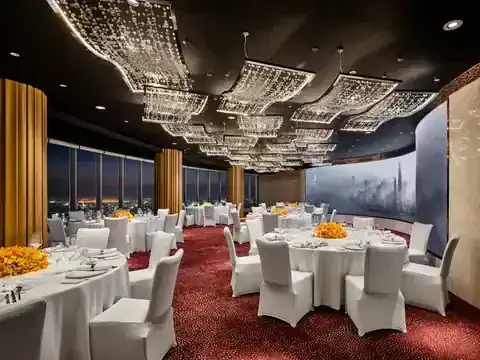
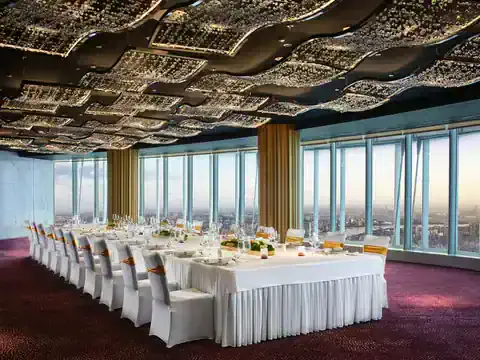
The venue is especially popular for:
- Luxury weddings
- Brand launches
- Executive conferences
- Gala dinners
- VIP corporate events
Integrated multimedia systems, curved LED screens, advanced audio-visual technology, and personalised event services reinforce the hotel’s positioning toward high-end luxury functions rather than mass-scale conferences.
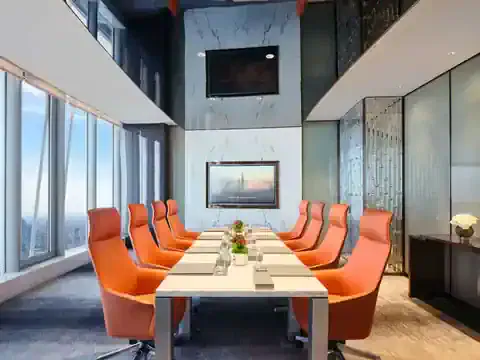
Smaller executive spaces include:
- Boardrooms
- Private meeting rooms
- Flexible breakout spaces
The overall atmosphere feels polished, discreet, and intentionally premium.
Wellness Facilities — Sky Recovery Zone (84F & 85F)
Located across floors 84 and 85, the wellness area is one of the hotel’s most atmospheric spaces.
Rather than functioning like a resort-style wellness complex, it feels more like a calm recovery zone suspended above the city.
Swimming Pool
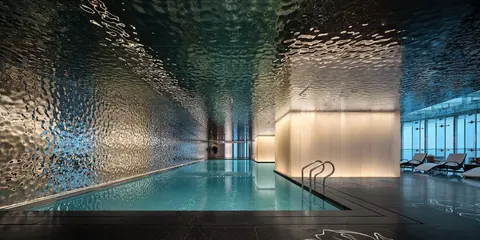
The indoor skyline-facing swimming pool stretches approximately 160 metres across part of Floor 84, creating one of the most visually dramatic wellness environments in Shanghai.
Reflections from the skyline at night completely change the mood of the space.
This is not designed as a high-performance athletic pool.
It is designed for atmosphere.
There is also a viewing deck beside the pool where guests can step directly into open skyline views above Pudong.
Fitness Centre
The fitness centre includes:
- Cardio equipment facing skyline views
- Free weights
- Stretching areas
- Yoga facilities
It rarely feels crowded, which adds to the hotel’s overall quiet atmosphere.
Working out here feels unusually cinematic because the skyline never disappears from view.
Spa (Reiki Spa)
The spa focuses more on decompression and recovery than large-scale wellness programming.
Treatments include:
- Massage therapy
- Aromatherapy
- Facial treatments
- Private treatment suites
The overall mood is intentionally subdued and calming rather than trend-driven or social-media-focused.
Butler Service — Quiet Luxury Detail
One detail that separates J Hotel from many newer luxury hotels in Shanghai is its personalised butler service.
Guests can request assistance with:
- Restaurant reservations
- Transport arrangements
- Itinerary planning
- Pillow preferences
- Laundry handling
- Luggage organisation
- Local recommendations
The service style feels polished and discreet rather than overly theatrical, which suits the hotel’s calm atmosphere particularly well.
Verdict — Honest Takeaway
J Hotel Shanghai Tower succeeds most when viewed as an experience hotel rather than a traditional luxury stay.
Inside the world’s third-tallest skyscraper, this is a property built around height, architecture, skyline drama, and spectacle.
And in those categories, very few hotels globally can compete.
What It Does Extremely Well
- Unmatched skyline elevation experience
- Huge rooms with strong spatial design
- Memorable dining venues
- Architectural significance inside Shanghai Tower
- Calm, visually striking wellness spaces
- Strong sense of occasion throughout the stay
Where It Falls Short
- High pricing versus repeat-stay practicality
- Some room views affected by structural exterior layers
- Atmosphere can feel emotionally distant
- Wellness facilities are elegant but not resort-scale
- Less suited for travelers wanting intimate boutique luxury
My Overall Takeaway
This is not the kind of hotel most people stay at repeatedly every month.
It is a “once,” “milestone,” or “special occasion” hotel.
But for architecture lovers, skyline chasers, luxury hotel enthusiasts, and first-time Shanghai visitors, it delivers one of the most visually unforgettable hotel experiences anywhere in the world.
10 Things to Know Before Booking
- Rooms start extremely high above street level
- Room orientation matters heavily for skyline quality
- Some windows include structural exterior layers
- Heavenly Jin requires advance reservations
- Breakfast can become busy during peak hours
- Pool atmosphere prioritises aesthetics over athletics
- The overall atmosphere is quiet and formal
- Suites feel significantly more residential
- Elevator transitions are part of the experience
- Rates fluctuate heavily during weekends and holidays
Quick FAQ
Q1: Is J Hotel worth it?
Yes — especially for architecture, skyline views, and the overall “experience hotel” factor.
Q2: What is the biggest highlight?
The skyline experience from both the rooms and Heavenly Jin restaurant.
Q3: How many floors are the rooms on?
Mainly floors 86–98.
Q4: Is it good for families?
Yes, although the atmosphere feels more suited to couples, business travelers, and luxury-focused stays.
Q5: Is breakfast included?
Usually yes depending on booking plan.
Q6: How long should you stay?
One to two nights is ideal for fully experiencing the property.
Q7: Is it better than other Shanghai luxury hotels?
It belongs in a different category — more experience-driven and architectural than purely comfort-driven.
Final Thoughts
J Hotel Shanghai Tower is not trying to compete directly with traditional luxury hotels in Shanghai.
Instead, it delivers something much more specific:
A vertical Shanghai experience inside one of the world’s tallest buildings.
It is dramatic, architectural, highly curated, and visually unforgettable.
If you approach it as a landmark experience hotel rather than simply a place to sleep, it absolutely delivers.
Related Coverage
Check out our full archive of travel reviews to discover the best stays and experiences.
J Hotel Shanghai Tower Welcomes Global Travelers to a Cloud-Piercing Stay
Festive Season at J Hotel Shanghai Tower
Jin Jiang International Named Official Travel and Hospitality Group Partner for ITB China 2026
