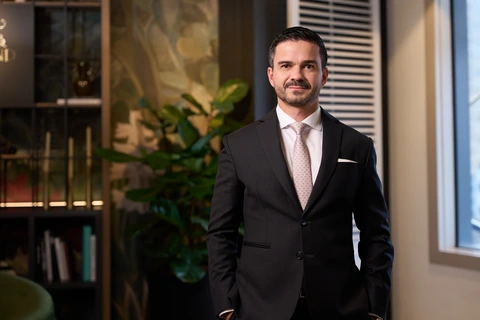
Sébastien Pisano, General Manager of Waldorf Astoria Bangkok, discusses Bangkok’s changing luxury market, personalised service, Chinese travellers, food and beverage, technology and the importance of discovering the city beyond its obvious landmarks.
Sébastien Pisano has returned to Bangkok with an international hospitality career that has taken him through different markets, including previous Hilton roles in Bangkok, the Maldives and Bora Bora, as well as experience connected to Provence’s wine estates.
Now General Manager of Waldorf Astoria Bangkok, Pisano is focused on a luxury hospitality model built around personal service, local discovery and human connection.
For Pisano, the opportunity is not simply to offer guests an elegant hotel in the centre of Bangkok, but to help them discover what he describes as the city’s “second layer” — the quieter neighbourhoods, local creativity, craftsmanship, food and everyday experiences that can reveal another side of the Thai capital.
Bangkok & Leadership
1. What are the biggest opportunities for Waldorf Astoria Bangkok over the next two to three years?
Bangkok continues to attract a very diverse mix of luxury travellers, and I see a strong opportunity for us to deepen our position as a hotel that feels genuinely connected to the city.
For us, that means continuing to elevate personalised service, strengthening our restaurants and bars as destinations in their own right, and helping guests discover what I sometimes think of as the second layer of Bangkok.
These are the places, stories and experiences they may not necessarily know to look for themselves, and our role is to uncover them according to their own interests, whether that is art, food, design, wellness, history or culture.
That is where our Personal Concierge can make the experience feel truly individual.
2. What makes Bangkok such an exciting — and challenging — luxury hotel market today?
Bangkok never stands still. At the same time, its hospitality scene is among the world’s best. New concepts continue to emerge, keeping competition high.
There is an extraordinary mix of culture, food, design, creativity and service, and new concepts are constantly emerging. That also makes the market extremely competitive.
Guests have an exceptional amount of choice, which pushes all of us to keep improving, stay creative and find new ways to remain relevant.
A beautiful hotel is no longer enough. You need a strong identity, consistency and a genuine reason for guests to return.
3. How would you describe your leadership style?
Trust and accountability are probably the two words that describe it best.
I believe in giving people ownership, encouraging them to make decisions and trusting them to deliver. I am also a very genuine person and I try to lead with sincerity and kindness because hospitality, ultimately, comes from the heart.
At the same time, I am competitive and I enjoy challenging the status quo. Bangkok is a wonderful market for that because the level of competition constantly encourages you to rethink what can be done better.
Waldorf Astoria Bangkok
4. How would you describe Waldorf Astoria Bangkok’s identity?
I see Waldorf Astoria Bangkok as a very elegant urban retreat that combines the grandeur and heritage of Waldorf Astoria with the warmth and refinement of Thailand.
There is a strong residential quality to the hotel, from André Fu’s interiors to the generous rooms and suites, and that creates a sense of privacy and calm in the middle of one of the world’s most energetic cities.
What makes it particularly special to me is the combination of that residential feeling with very personal service through our Personal Concierge. It creates a private world from which Bangkok can gradually unfold around the guest.
5. How do you combine the Waldorf Astoria brand with a strong sense of Bangkok?
The beauty of a global luxury brand is having a strong heritage while still allowing every hotel to belong completely to its destination.
At Waldorf Astoria Bangkok, Bangkok comes through in many subtle ways. It can be in the ingredients we use, the food we serve, the craftsmanship and design, or simply in the way our team introduces guests to the city.
I also believe our role goes beyond showing guests the Bangkok they already know.
We want to open the door to another side of the city, with quieter neighbourhoods, local creativity, craftsmanship, food and everyday rituals that reveal something more personal.
Waldorf Astoria gives us the heritage and Bangkok gives the hotel its soul.
6. Does the hotel’s relatively small number of rooms help you provide more personalised service?
Absolutely.
We are one of the smaller luxury hotels within our market, and I see that as a real advantage. It allows us to create a much more personal relationship with our guests.
Our Personal Concierge is central to that. The objective is not simply to respond to requests, but to understand why a guest is travelling, what they enjoy, and then tailor the stay around them.
That ability to tailor-make the experience is, for me, a very important part of modern luxury.
7. What do you hope guests remember most about their stay?
More than anything, I hope they remember how we made them feel.
Of course, they may remember the design, the views or their dining experiences, and we are always touched when guests tell us that breakfast was among the best they have had.
But the memories that stay with people are usually more personal: a thoughtful gesture, a genuine conversation, something anticipated before they had to ask, or discovering a side of Bangkok they may not have found on their own.
If guests leave feeling that we understood them, cared for them sincerely and helped them connect with the city in a way that felt personal, then I believe we have fulfilled our mission.
Luxury Travellers
8. How are luxury travellers’ expectations changing?
Luxury travellers are becoming more selective and more individual in what they value.
They still expect exceptional quality, but they are also looking for authenticity, flexibility, wellness, ease and experiences that feel personal.
Increasingly, they also want personal engagement. They value conversation, recognition and the feeling that someone has taken a genuine interest in them.
They want hotels to understand them without making the experience feel scripted.
9. How have Chinese luxury travellers’ expectations changed in recent years?
Chinese luxury travellers today are extremely well travelled and their expectations are very high.
Many are sophisticated, independent and highly informed before they arrive. They are interested not only in the hotel itself, but also in dining, design, wellness, culture and experiences that feel unique to the destination.
Digital convenience and recognition remain important, but so does originality. They increasingly want access to something they could not simply find themselves online.
10. How is the hotel adapting to younger luxury travellers?
Younger luxury travellers value experiences and stories as much as traditional luxury symbols. They also want design, food and a stronger sense of place.
Our role is to remain relevant to them without losing the timelessness and service standards of Waldorf Astoria.
Food & Beverage
11. How important is F&B to the hotel’s identity?
Food and beverage has been part of the Waldorf Astoria DNA for more than a century.
The original Waldorf Astoria in New York was not simply a hotel, but a social institution, and many of the brand’s most enduring stories were created around food and drink.
In Bangkok, we carry that heritage forward through venues with very distinct personalities.
Bull & Bear, Bangkok’s highest steakhouse on the 55th floor, combines live fire cooking, premium cuts and dramatic skyline views.
The Loft, one floor above, draws inspiration from historic recipes from the Old Waldorf Bar and the Waldorf Astoria Bar Book, reinterpreting them through contemporary mixology. Its recognition by Forbes Travel Guide, Asia’s 50 Best Bars and Tatler is something we are particularly proud of.
Peacock Alley is another important expression of the brand, carrying forward one of Waldorf Astoria’s most iconic traditions through afternoon tea, elegant social occasions and a sense of timeless sophistication.
Together, these venues allow us to celebrate the heritage of Waldorf Astoria while creating experiences that feel relevant to Bangkok today.
For me, that is what strong hotel food and beverage should do. It should not simply serve the guests staying with us, but earn a place in the life of the city.
12. How do you present Thai cuisine to international guests while keeping it authentic?
At Front Room, we wanted to create a way for guests to understand Thai cuisine rather than simply taste it.
Thai cuisine is built around eight essential flavour elements, and our concept is centred on that principle. It gives us a framework through which guests can understand the balance and complexity of Thai food while we remain completely faithful to its taste and character.
The presentation may be refined, but the flavours are recognisably Thai.
13. How important are local residents to the success of the hotel’s restaurants and bars?
They are essential.
Historically, the Waldorf Astoria in New York was a place to be and to be seen, and I think that sense of social relevance remains important for the brand today.
Our success cannot be defined only by the guests staying in the hotel. It is also defined by whether people living in Bangkok choose to come to us for dinner, drinks, afternoon tea, celebrations or simply to spend time.
Our relevance within the Bangkok scene is a very important measure of success.
Bangkok as a Destination
14. How has Bangkok changed as a luxury destination?
Bangkok has become much more multidimensional.
Luxury is no longer limited to hotels and shopping. Today you have exceptional restaurants, contemporary art, independent designers, wellness, neighbourhood experiences and a much stronger creative scene.
There is also a growing confidence in contemporary Thai creativity.
At the same time, the competitiveness of Bangkok’s hospitality scene is pushing everyone to elevate their offer and constantly become more creative.
That energy is ultimately very positive for the destination and for travellers.
15. What do international visitors sometimes misunderstand about Bangkok?
Sometimes people expect Bangkok to be defined only by its energy and intensity.
Of course, that is part of its character, but there is another side to the city that visitors do not always see immediately.
Bangkok can also be remarkably calm, spiritual and even healing. There are quieter neighbourhoods, temples, local artisans, contemporary galleries, historic communities, green spaces and small restaurants that create a completely different rhythm.
Discovering that second layer often changes the way people understand the city.
16. What would you recommend to someone visiting Bangkok for the first time?
I would tell them not to try to see everything.
Start early and experience how the city changes throughout the day. Walk through Lumphini Park in the morning and see Bangkok waking up.
Visit the Erawan Shrine or a temple, make merit, have your fortune told, or simply observe how spirituality remains part of daily life here.
Explore a neighbourhood such as Charoenkrung or Talat Noi, discover somewhere small and local for lunch, and then return to the hotel for a little time by the pool or at the spa before enjoying Bangkok again in the evening.
What I love most is the contrast between all these moments. That is when you begin to understand the city beyond its obvious landmarks.
Technology & the Future
17. How do you see AI and technology changing luxury hospitality?
I see technology primarily as a way to make the guest experience more seamless while giving our teams more time to be present with guests.
We recently introduced a digital hotel directory and digital in-room dining ordering, which means information can be updated instantly without having to reprint materials for every room, and guests can browse menus visually, order at their fingertips and chat with us directly when they need assistance.
These are simple changes, but they remove friction and make the experience more intuitive.
The real value for me is that technology can also reduce administrative and back-office time, allowing our Team Members to spend more time face-to-face with guests.
That is where technology should take luxury hospitality, toward better service and more human interaction.
18. Where should hospitality remain human?
In empathy, judgement and genuine connection.
Technology can recognise a preference, but it cannot fully replace the instinct of an experienced colleague who understands when a guest needs assistance, privacy, reassurance or simply a warm conversation.
Those moments are at the heart of hospitality.
19. What has Bangkok taught you about hospitality?
Bangkok has reinforced for me how important warmth and generosity are.
Thai hospitality can feel very natural and intuitive. There is an ability to make people feel welcome without making the service feel forced, and that is something very special.
20. What do you think will define successful luxury hotels in Bangkok over the next five years?
I believe it will start with a clear identity.
In a market as competitive as Bangkok, hotels need to know exactly what they stand for and express it consistently.
The next step is the ability to unlock the local secrets of the destination and give guests access to places, people and experiences they would not necessarily discover on their own.
Wellness will continue to grow in importance as travellers become more conscious of how they feel during and after a journey.
And finally, efficiency will be essential. Guests are increasingly well informed, have enormous choice and expect things to be seamless and right the first time.
The most successful hotels will combine all four without losing warmth or personality.
Rapid Fire
To round up the interview, we asked Sébastien Pisano a series of quick-fire questions — from his preferred Bangkok view and neighbourhood to his choice between Thai and French food.
Bangkok or Paris?
Bangkok
Morning person or night owl?
Morning person
Coffee or tea?
Coffee
Thai food or French food?
Impossible choice.
Street food or fine dining?
Both. It depends on the occasion.
City view or garden view?
City view
Pool or spa?
Pool
Window seat or aisle seat?
Aisle seat
Favourite Bangkok neighbourhood?
The old town, for its history and character.
One Bangkok experience every visitor should have?
Walk through Lumphini Park early in the morning and watch Bangkok come to life.
One word for luxury?
Bespoke
One word for Bangkok?
Unexpected
One thing you never leave Bangkok without doing?
Enjoying a great Thai meal
Check Availability
Travelers planning their trips can compare prices for hotels, tours, and travel experiences across multiple booking platforms.
- Compare hotel prices on Trip.com
- Explore tours and travel experiences on Klook
- Disclosure: Affiliate links included. We may earn a commission at no extra cost to you.
Related Coverage
Waldorf Astoria Shanghai on the Bund Lit Up Last Night
Waldorf Astoria Kuala Lumpur Opens Reservations Ahead of Malaysia Debut
Interview with Area General Manager for Waldorf Astoria Greater China and Mongolia
Waldorf Astoria Osaka Heralds a New Dawn of Luxury in Japan
Read our full collection of travel interviews with industry leaders and hospitality experts.
