
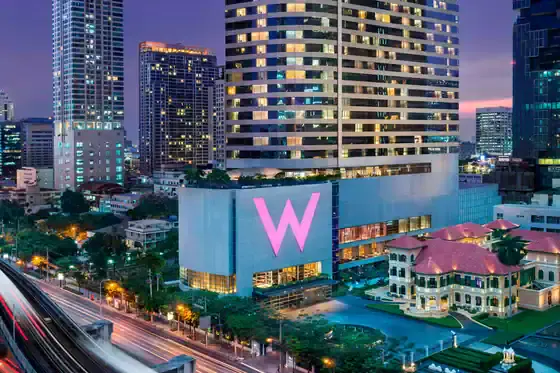
Alexander Kellermann has a long history with W Bangkok. After spending more than seven years with the hotel, progressing from Director of Rooms to Hotel Manager, he returned as General Manager in 2023.
Since then, Kellermann has focused on keeping the established W property relevant in Bangkok’s increasingly competitive luxury-hotel market while preserving the personality that has defined the brand.
His career has also taken him through Vienna, New York and Shanghai, as well as different areas of hotel operations. Having started in housekeeping, he says the experience continues to influence his approach to leadership.
In this interview with Red Bird Travel News, Kellermann discusses his return to W Bangkok, human-centric leadership, changing luxury-traveler expectations, sustainability, artificial intelligence, talent and his vision for the hotel’s next chapter.
Returning to W Bangkok
You spent more than seven years at W Bangkok, progressing from Director of Rooms to Hotel Manager, before returning as General Manager in 2023. What has changed most about the hotel — and about you as a hotelier — since you first joined W Bangkok?
W Bangkok has matured. When the hotel opened, it was introducing a completely different style of luxury to the market. Today, the challenge is less about being new and more about remaining relevant, innovative, and authentic while staying true to the brand.
Personally, I’ve evolved from focusing primarily on operations to thinking more strategically about culture, owner relations, profitability, and long-term positioning. What hasn’t changed is my belief that hospitality is fundamentally about people. Great buildings and great concepts matter, but ultimately our associates create memorable experiences.
Lessons from different markets
You have worked in Vienna, New York, Shanghai and Bangkok, across both luxury hotels and serviced residences. What have those different markets and properties taught you that you now apply to your leadership at W Bangkok?
Every market teaches you something different. Vienna taught me discipline and attention to detail. New York taught me pace and commercial agility. Shanghai showed me the importance of innovation and adapting to rapidly changing consumer behavior. Bangkok reinforces the power of genuine hospitality and emotional connection.
What I’ve learned is that while guest expectations differ across markets, people everywhere want to feel recognized, valued, and understood. That’s a universal principle that guides how we lead at W Bangkok.
From housekeeping to GM
You began your career in housekeeping and rose through hotel operations. How has that experience shaped the way you lead a hotel today?
Starting in housekeeping taught me humility and respect for every role within a hotel.
When you’ve cleaned rooms and worked overnight shifts, you gain a deep appreciation for the effort required to deliver a seamless guest experience. It also reinforces that leadership isn’t about hierarchy. My role is to remove obstacles, support the team, and create an environment where people can succeed.
Human-centric leadership
You describe yourself as a human-centric leader. What does that mean in practical terms when you are running a large hotel, and how do you balance empowerment with performance expectations?
For me, human-centric leadership means treating associates as individuals, not simply job titles.
People perform best when they understand the purpose behind what they do, feel trusted, and know their leaders genuinely care about their development. At the same time, empowerment comes with accountability. We set clear expectations, provide support and coaching, and then trust people to make decisions.
The best teams are those where people feel both cared for and challenged.
Keeping W Bangkok relevant
W Bangkok has been established in the city for more than a decade. How do you keep an established W property feeling fresh and relevant in one of Asia’s most competitive luxury-hotel markets?
You never stand still.
That means continuously investing in the physical product, evolving our food and beverage offerings, embracing new technologies, and staying connected to what’s happening culturally within Bangkok.
We’re currently investing significantly across various areas of the hotel to ensure we remain one of the city’s most exciting lifestyle destinations while preserving the character guests have come to love.
What sets W Bangkok apart?
What do you think distinguishes W Bangkok from the growing number of luxury and lifestyle hotels now competing for the same Bangkok traveler?
Many hotels can offer beautiful rooms and excellent facilities. What differentiates W Bangkok is its personality.
We combine the energy of the W brand with a genuine connection to Bangkok. Whether it’s our design, music, social atmosphere, culinary experiences, or service culture, guests feel they’re staying somewhere that has a distinct identity rather than a hotel that could exist anywhere in the world.
Opportunities in Bangkok
Bangkok’s luxury hotel scene has become increasingly competitive. Where do you see the biggest opportunities for W Bangkok over the next few years?
The biggest opportunity is creating experiences that are harder to replicate.
We’re focused on further elevating our suites, strengthening our food and beverage positioning, and unlocking the full potential of The House on Sathorn as one of Bangkok’s most iconic lifestyle and dining destinations.
Luxury travelers increasingly seek experiences, not just accommodation, and that’s where we see significant growth opportunities.
A changing international traveler
How are you seeing the mix and expectations of international travelers to Bangkok change?
Today’s travelers are more informed and more selective.
Guests want authentic local connections, personalized experiences, seamless technology, and increasingly sustainable travel options. We are also seeing continued growth from regional Asia-Pacific markets while international demand from Europe and North America remains strong.
The expectation is no longer simply luxury. Guests want luxury with meaning and relevance.
Sustainability as culture
W Bangkok has developed its rooftop farm and has made food-waste reduction a significant part of its sustainability efforts. How do you turn sustainability from an initiative into something that genuinely becomes part of the hotel’s everyday culture and guest experience?
Sustainability becomes meaningful when it moves beyond projects and becomes part of daily decision-making.
Our rooftop farm, food-waste initiatives, and operational practices are important, but culture is what drives lasting change. We work hard to educate associates, measure outcomes, and find ways to connect environmental responsibility with guest experiences.
When associates understand why it matters, sustainability becomes part of who we are rather than something we simply do.
ESG and business
You have also written about ESG as a business driver rather than simply a compliance exercise. Where do you think hotels still have the greatest opportunity to make sustainability commercially meaningful?
The greatest opportunity lies in finding areas where sustainability and business performance align.
Reducing food waste, lowering energy consumption, improving resource efficiency, and strengthening community partnerships all create operational benefits while reducing environmental impact.
The future of ESG is moving beyond compliance toward creating measurable business value alongside positive social and environmental outcomes.
AI and hospitality
You have written and spoken about AI, human behaviour and hospitality. Where do you see AI having the greatest practical impact on hotels over the next three to five years?
I believe AI will significantly enhance decision-making, personalization, revenue management, forecasting, and administrative efficiency.
Hotels generate enormous amounts of data, and AI can help leaders and associates transform that information into more informed and timely decisions. As the industry embraces AI, maintaining guest trust through responsible data practices, privacy and transparency will be critical.
In hospitality, the greatest opportunity is not technology itself, but how it enables people to spend more time with guests. AI can take care of repetitive and administrative work, allowing associates to focus on creating memorable experiences, building relationships, and delivering the human connection that defines great hospitality.
What should remain human?
What parts of hospitality should technology automate — and what parts should remain resolutely human?
Technology should automate friction.
Routine administrative work, data analysis, reporting, and transactional processes can often be handled more efficiently through technology.
What should remain human are the moments that create emotional connection. Empathy, anticipation, creativity, problem-solving, and genuine hospitality cannot be automated. Guests may remember a fast check-in, but they remember how someone made them feel.
Finding and retaining talent
Hospitality continues to face challenges in attracting and retaining talented people. What qualities do you look for when hiring someone for W Bangkok, and what do you do to keep good people?
We can teach technical skills. Attitude is much harder to teach.
I look for curiosity, authenticity, adaptability, and a genuine desire to serve others. Once people join us, retention comes from creating opportunities for growth, recognizing contributions, investing in development, and building a culture where people feel they belong.
Personality versus consistency
W has always been a brand where personality, individuality and creativity matter. How do you create an environment where employees can express themselves while still maintaining consistent service standards?
Those two things are not opposites.
We establish clear service fundamentals and brand expectations, but we encourage associates to bring their own personalities into guest interactions. Authenticity creates stronger connections than scripted service.
The goal is consistency of experience, not uniformity of personality.
The next chapter
Looking ahead, what is the next chapter you want to write for W Bangkok? If we come back three years from now, what would you like to have changed?
I’d like W Bangkok to be recognized not only as one of Bangkok’s leading luxury lifestyle hotels but as one of Asia’s.
That means completing our transformation journey, elevating our suites and public spaces, strengthening The House on Sathorn’s position in the market, further developing our associates, and continuing to create memorable guest experiences that differentiate us from the competition.
Success will not simply be measured by financial performance, but by the impact we have on guests, associates, and the community around us.
Rapid Fire
To wrap up our conversation, we put Alex through a quick rapid-fire round of questions.
Bangkok in three words?
Dynamic. Creative. Resilient.
W Bangkok in three words?
Bold. Social. Unexpected.
Favorite Thai dish?
Massaman Curry.
Favorite Bangkok neighborhood?
Sathorn. It combines energy, history, dining, and culture.
City break or beach escape?
Beach escape, although a great city always inspires me.
Data or instinct?
Data-informed instinct.
One hotelier you admire?
Manuel Martinez.
Your definition of luxury?
Being genuinely understood without having to ask.
Whatever/Whenever — what’s the most unusual request you’ve ever received?
Over the years there have been many unusual requests, but the most memorable are often the highly personal ones. Guests have asked us to transform spaces overnight for surprise celebrations, proposals, or once-in-a-lifetime moments.
Those are the requests that remind you hospitality is ultimately about creating memories, not simply providing accommodation.
Check Availability
Travelers planning their trips can use the following tools to compare prices for hotels, tours, and travel experiences across multiple booking platforms. For more online travel agency offerings, visit our OTA page.
- Compare hotel prices on Trip.com
- Explore tours and travel experiences on Klook
- Disclosure: Affiliate links included. We may earn a commission at no extra cost to you.
Related Coverage
Bar Sathorn Named No. 17 on Asia’s 50 Best Bars 2026
W Hotels Launches a New Global Season of Hotel Tales
Read our full collection of travel interviews with industry leaders and hospitality experts.
