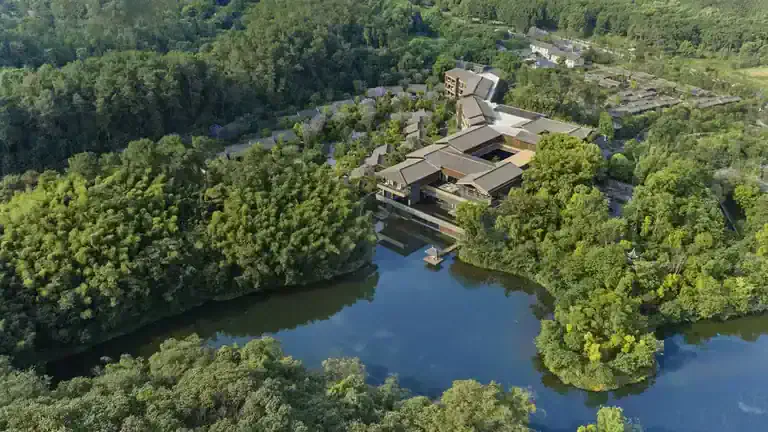
Banyan Group, the independent global hospitality company behind Banyan Tree, has expanded its presence in China with the opening of Banyan Tree Mount Emei in Sichuan Province.
Set in the foothills of Mount Emei, also known as Emeishan, the new resort provides a gateway to the Mount Emei Scenic Area. The area forms part of a UNESCO World Heritage Site recognised for its cultural and natural significance, as well as its rich biodiversity.
Inspired by the traditional courtyard homes of western Sichuan, Banyan Tree Mount Emei reinterprets local architecture in a contemporary setting. The design follows the natural contours of a forested valley, while landscaping and guest experiences draw on the surrounding environment and regional culture.
Banyan Tree Mount Emei: At a Glance
- 130 rooms and villas across six categories
- Every room and villa features a private outdoor hot spring pool
- Banyan Tree Spa with five private treatment rooms
- Bamboo forest trails and nature-focused experiences
- Jiayao Chinese Restaurant and Mingyue All-Day Dining
- More than 1,200 square metres of indoor and outdoor event space
- Five-minute drive from Emeishan High-Speed Railway Station
- Approximately two minutes from the Mount Emei Scenic Area entrance
A Resort Designed Around Nature
Nature was central to the development of Banyan Tree Mount Emei. Seven century-old camphor trees were retained in their original locations. In addition, all existing trees with trunks measuring more than 10 centimetres in diameter were preserved.
The resort’s pathways wind through a bamboo forest and follow the natural terrain. Bamboo therefore grows alongside and through the walkways, helping maintain the character of the original landscape.
Guests arriving at the resort pass beneath mature camphor trees before reaching an open-air courtyard. The space takes inspiration from the traditional Chinese architectural principle of “four waters returning to the hall”, or si shui gui tang.
In this traditional design concept, pitched roofs direct rainwater towards a central courtyard. Throughout the resort, filtered light, mountain air, the sound of water and views of bamboo groves create a strong connection between architecture and nature.
Rooms and Villas with Private Hot Springs
Banyan Tree Mount Emei features 130 rooms and villas across six categories. Each accommodation includes a private outdoor hot spring pool, adding a distinctive wellness element to the stay.
Mountain View Rooms overlook the changing scenery across the seasons. Meanwhile, Garden Villas open onto private gardens, while the one- and two-bedroom Lakeside Villas feature landscaped courtyards beside the water.
At 320 square metres, the Presidential Villa offers additional space and privacy for families and small groups. The villa includes a private garden of a similar size, as well as a terrace overlooking the forest and stream.
Wellbeing and Cultural Immersion
At Banyan Tree Mount Emei, wellness experiences are closely connected to the surrounding landscape.
The Banyan Tree Spa draws on Asian healing traditions and local inspiration. It features five private treatment rooms designed for couples, together with a rainforest-inspired hydrothermal experience and spa café.
Beyond the spa, guests can explore the bamboo forest trail, practise yoga in the morning light or experience weightless floating therapy. The temperature-controlled swimming pool also offers 180-degree views across the bamboo groves and lake.
For those who want to maintain their daily routine, a dedicated yoga studio and fitness centre provide additional spaces for movement and exercise.
Local culture is another important part of the resort experience. Banyan Tree Gallery showcases a curated selection of local crafts and cultural creations while supporting artisans and makers from the surrounding community.
Guests can also explore Emei martial arts, traditional tie-dyeing and bamboo weaving through hands-on activities. Younger travellers can take part in nature, exploration and art at Terra Kids Club, where discovery, creativity and play come together.
Sichuan Flavours and Destination Dining
Dining at Banyan Tree Mount Emei reflects the culinary traditions of Sichuan while incorporating Cantonese and international influences.
Jiayao Chinese Restaurant focuses on locally sourced ingredients and regional specialities. The menu also features Cantonese favourites and contemporary interpretations.
At Mingyue All-Day Dining, Chinese and international flavours are presented alongside seasonal ingredients and health-conscious choices. Guests can enjoy their meals while taking in views of the lake and surrounding mountains.
At the Lobby Lounge, afternoon tea transitions into evening drinks as the light changes across the landscape.
For a more private experience, Banyan Tree’s signature Destination Dining programme offers a selection of outdoor settings. Guests can enjoy afternoon tea aboard a traditional black-canopy boat, dine at the Mid-Lake Pavilion or gather among the bamboo forest.
The Study Room also provides an intimate setting for tea and conversation.
Events and Celebrations Surrounded by Nature
Banyan Tree Mount Emei offers more than 1,200 square metres of flexible indoor and outdoor event space for meetings, celebrations and private gatherings.
The pillarless Xiangzhang Ballroom covers 500 square metres and is complemented by an approximately 220-square-metre foyer and garden terrace. As a result, events can move between indoor and outdoor spaces.
Within the bamboo forest, the 500-square-metre Forest Platform provides a more immersive setting. Bamboo borders one side of the platform, while pine trees frame the other.
The Study Room is set apart from the resort’s main buildings. Its name comes from Huizong Hall, the original name of nearby Baoguo Temple.
Designed by contemporary Chinese architect Zhuang Ziyu, the building follows the natural contours of the mountainside. Inside, six multifunctional rooms can host cultural gatherings, private dining, tea rituals and calligraphy experiences.
Getting to Banyan Tree Mount Emei
Banyan Tree Mount Emei is approximately a five-minute drive from Emeishan High-Speed Railway Station. The resort is also around two minutes by car from the entrance to the Mount Emei Scenic Area.
For international and domestic travellers arriving by air, Chengdu Shuangliu International Airport is approximately two hours away by car. Chengdu Tianfu International Airport is around two hours and 15 minutes away.
Meanwhile, Leshan Airport is expected to begin operations later in 2026. Once operational, the airport is expected to be approximately 40 minutes from the resort by car.
With its combination of private hot springs, bamboo forests, wellness experiences and connections to local culture, Banyan Tree Mount Emei offers a nature-focused base for exploring one of Sichuan’s most significant destinations.
