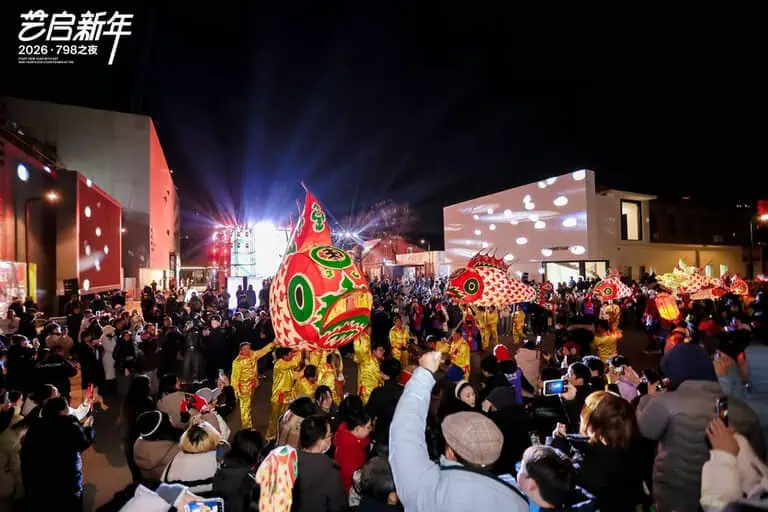
Beijing’s 798 Art District marked the arrival of 2026 with a large-scale New Year’s Eve celebration that transformed the former industrial zone into a city-wide stage, drawing nearly 130,000 visitors and positioning contemporary art at the centre of public life as the capital entered the new year.
Travelers can find more information about BEIJING and explore accommodation details on Trip.com. Some links in this article are affiliate booking links, which may earn me a small commission at no extra cost to you.
A Cultural Alternative to the Conventional Countdown
Held on the final night of 2025, Starts New Year with Art: 2026 New Year’s Eve Countdown at 798 unfolded across the district’s entire 520,000 square metres, making it one of the largest public art-led New Year’s Eve events in Beijing.
Rather than focusing on a single countdown clock or fireworks display, the event was organised around one landmark-scale centrepiece, eight themed venues and dozens of satellite programmes spread throughout the district. The approach offered a distinct alternative to traditional countdown spectacles, emphasising participation, contemporary creativity and the reuse of industrial heritage.
Nearly 200 galleries, museums, performance venues and businesses extended their operating hours late into the night, creating a temporary cultural ecosystem that blended exhibitions, live performances, light installations and creative markets.
Six Countdown Sites Across the District
This year’s celebration departed from the single-location countdown model. Instead, six synchronised countdown points were distributed across the district, allowing visitors to encounter the transition into 2026 from multiple vantage points.
One of the most prominent installations appeared on the district’s iconic No. 6 chimney. Woven Light Chronicles, a digital artwork led by artist Wang Zhigang, transformed the chimney into a vertical canvas of shifting light, repurposing a symbol of industrial production as a marker of time and renewal.
Nearby, the former oil storage structure known as the “79 Tank” hosted Endless Circle, a time-based light installation projected onto its concrete and steel interior, reinforcing the event’s theme of cyclical time and collective experience.
Additional countdown moments appeared across the site, including:
- Large LED screens at Power Square
- Architectural projections beneath the Twin Tower
- Light interventions along factory façades, walls and archways
The result was a decentralised countdown in which the arrival of 2026 unfolded simultaneously across the district.
Art, Performance and Public Participation
Public participation played a central role throughout the evening. A newly expanded installation reading “Dear Beijing, Happy New Year” emerged as a focal gathering point, attracting visitors for photographs and informal celebrations.
Illuminated trees across the district carried handwritten wishes from attendees, while interactive installations invited visitors to symbolically leave behind anxieties and unresolved emotions from the past year. These participatory elements reinforced the event’s emphasis on collective reflection rather than spectacle alone.
Live performances unfolded in dialogue with public art and architecture. Folk-rock band Wu Tiao Ren and electronic act Nova Heart headlined the main stage, while smaller performances were distributed throughout the district.
Cross-disciplinary works combined:
- Live music and digital visuals
- Contemporary dance and public installations
- Improvised performances in repurposed industrial spaces
Traditional Culture Reimagined in an Industrial Setting
Alongside contemporary works, traditional cultural forms were woven into the night’s programme. Classical dance performances, fish-lantern parades and contemporary reinterpretations of lion dances moved through the crowds, blending heritage practices with modern urban space.
These performances underscored the district’s ongoing role as a site where historical memory, industrial legacy and contemporary expression intersect. The use of former factories and warehouses as performance backdrops reinforced the visual contrast between past and present.
798’s Role in Beijing’s Nighttime Economy
Designated as a national nighttime cultural and tourism hub, the 798 Art District has increasingly positioned art and culture as drivers of urban vitality after dark. The scale and attendance of the New Year’s Eve event highlighted the district’s capacity to host large public gatherings while maintaining a cultural focus.
Organisers noted that several installations from the countdown will remain on view through the holiday period, extending the impact of the event into the first days of 2026 and encouraging continued visitation.
The celebration also demonstrated how cultural districts can serve as alternatives to commercialised or centralised countdown events, offering distributed experiences that integrate art, public space and community participation.
A Snapshot of Art-Led Urban Celebration
As Beijing welcomed 2026, the 798 Art District’s New Year’s Eve programme offered a snapshot of how contemporary art can function beyond gallery walls — as infrastructure for public gathering, shared reflection and urban celebration.
By combining large-scale installations, live performance and participatory works across an entire district, the event reinforced 798’s evolving role in the city’s cultural landscape and highlighted growing public appetite for art-driven civic experiences.
At a Glance
- Event: Starts New Year with Art: 2026 New Year’s Eve Countdown at 798
- Location: 798 Art District, Beijing
- Date: 31 December 2025
- Attendance: Nearly 130,000 visitors
- Scale: 520,000 square metres across the full district
- Key Features: Six synchronised countdown sites, light installations, live music, public participation
- Headline Installations: Woven Light Chronicles (No. 6 chimney), Endless Circle (79 Tank)
- Legacy: Select installations remain on view into early 2026
Also read Luminous New Year Afternoon Tea at The St. Regis Beijing
