Despite inflation pressures, geopolitical conflicts and uneven consumer spending, the world’s largest hotel companies believe global travel demand remains remarkably resilient heading into the second half of 2026.
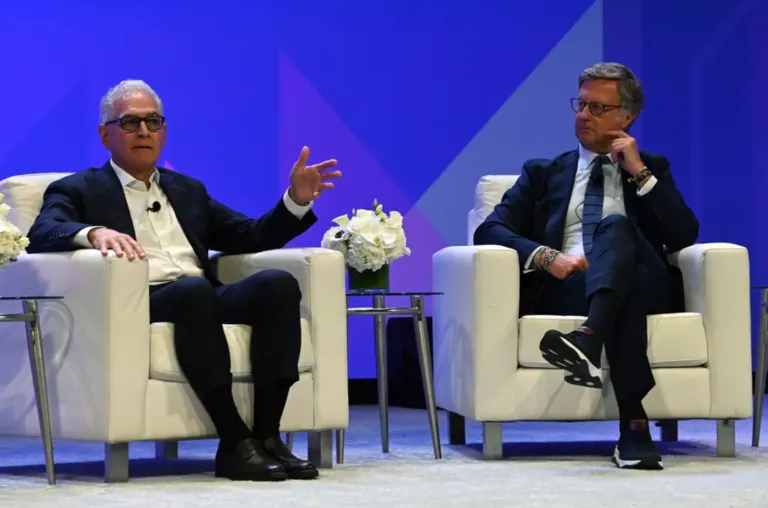
Speaking during the “View from the Boardroom” session at the NYU International Hospitality Investment Forum, executives from Hilton, Hyatt, IHG Hotels & Resorts and Accor outlined why they remain optimistic about the long-term outlook for the global hotel industry — even as travelers adjust destinations, budgets and booking behavior.
The consensus from hotel leaders was clear: travelers are still prioritizing experiences and mobility, while global diversification is helping major hotel groups absorb regional shocks.
Hilton Sees “C-Shaped” Recovery Emerging
Chris Nassetta, president and CEO of Hilton, said the hotel industry is beginning to move beyond the uneven “K-shaped economy” that defined the post-pandemic recovery.
According to Nassetta, luxury and upper-tier hotels initially outperformed while middle and lower chain-scale segments struggled under inflationary pressure. However, performance trends are now beginning to converge.
He described the current environment as a “C-shaped economy” — with “C” representing convergence across market segments.
Nassetta pointed to improving hotel results from late 2025 into 2026, supported by infrastructure investment, deregulation and growing spending tied to artificial intelligence and data center development.
Major U.S. investment programs, including infrastructure and semiconductor initiatives, are now feeding into broader economic activity, he said, helping stimulate middle-class employment and travel demand.
Hyatt Says Leisure Travel Remains Exceptionally Strong
Mark Hoplamazian said Hyatt Hotels Corporation continues to benefit from strong high-end leisure demand.
More than half of Hyatt’s revenue now comes from leisure travel, a major increase from pre-pandemic levels when leisure represented roughly one-third of the company’s business.
Hoplamazian said the shift does not reflect weaker business travel, but rather sustained expansion in leisure spending among higher-income travelers.
Hyatt is also expanding further into the upper-midscale segment to broaden its customer reach while maintaining alignment with its existing guest base and brand positioning.
IHG Highlights Strength of Global Diversification
Elie Maalouf said IHG Hotels & Resorts continues to benefit from its geographically diversified portfolio.
While the Middle East experienced softer travel demand linked to regional tensions and the U.S.-Iran conflict, Maalouf said strong performance in the United States, China, Europe and Southeast Asia helped offset the weakness.
He emphasized that disruptions have become a recurring feature of the travel industry, referencing the war in Ukraine, tariffs and geopolitical uncertainty.
According to Maalouf, global hotel companies with diversified brand and regional exposure are better positioned to absorb temporary downturns and redirect demand.
He also noted that recovery in the Middle East appears to be progressing faster than many expected.
Accor Says Travelers Are Changing Destinations — Not Canceling Trips
Sébastien Bazin said Accor has also seen travelers shift destinations rather than abandon travel plans altogether.
As demand softened in destinations such as Dubai and Abu Dhabi, Accor saw travelers redirect trips toward Egypt and Morocco, where the company also maintains a strong presence.
Bazin said loyalty programs and brand recognition are helping the company retain guests within its global network even when travelers change destinations.
The Accor chief added that Europe remains one of the world’s strongest long-term tourism markets due to its enduring global appeal and constrained capacity growth.
AI Investment and Infrastructure Spending Seen Supporting Travel Economy
A recurring theme throughout the discussion was the broader economic impact of artificial intelligence investment and infrastructure expansion.
Executives argued that while technology firms and hyperscalers are driving data center growth, the economic benefits extend well beyond Silicon Valley.
Hotel leaders highlighted rising demand for construction, power infrastructure, industrial equipment and fiber-optic networks — industries that support middle-class employment and, in turn, leisure and business travel.
Maalouf noted that companies tied to infrastructure expansion are experiencing sustained demand, while Bazin argued that a stronger middle class ultimately supports long-term travel growth.
Europe’s Tourism Dominance Continues to Strengthen
Bazin also emphasized Europe’s structural tourism advantage, noting that roughly half of global international travelers historically visit Europe.
With the global population continuing to expand and more consumers entering the travel market, Europe’s major gateway cities are expected to see continued visitor growth over the coming decade.
For hotel operators, the opportunity is no longer simply attracting travelers — but encouraging them to stay longer and spend more across destinations.
Why This Matters for Travelers and the Hotel Industry
The discussion at NYU reflected a broader industry belief that global travel demand remains fundamentally strong despite economic volatility.
Instead of canceling trips outright, travelers are increasingly adapting by changing destinations, shortening flights, shifting spending patterns or prioritizing value-driven experiences.
For global hotel companies, diversification, loyalty ecosystems and exposure to leisure demand continue to provide resilience in an unpredictable environment.
As artificial intelligence investment, infrastructure development and global mobility trends continue reshaping economies, hotel leaders believe the travel industry remains positioned for long-term growth rather than contraction.
Related Coverage
LHW 2025 Annual Convention: Leading with Purpose in a New Era of Luxury Hospitality
FHS World 2026 Expands Dubai’s Role in Global Hospitality Investment
Editorial disclosure: This article is an independently written editorial analysis based on industry reporting from CoStar News Hotels and insights from Bryan Wroten. The content has been rewritten and contextualised for editorial clarity and relevance.
