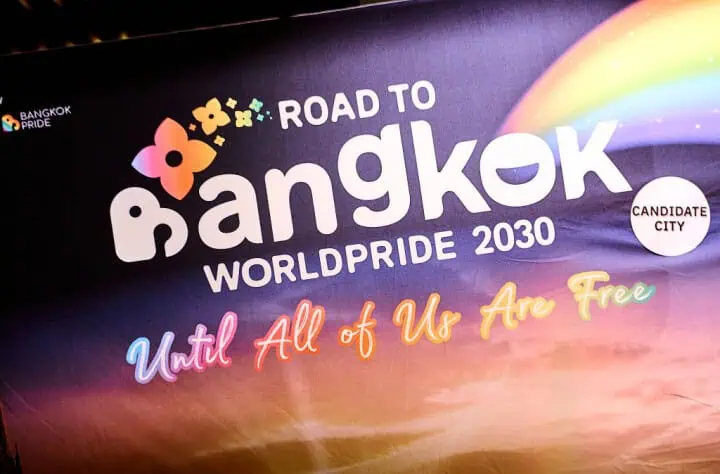
Bangkok’s bid to host WorldPride 2030 aims to expand LGBTQIA+ representation, regional cooperation and human rights advocacy across Asia, with a focus on supporting activists and communities beyond the host city.
Bangkok Pride, the official applicant and host, has proposed giving Asian activists and organisations a meaningful role in the event. The bid also seeks to strengthen ties with international partners and build support that continues beyond 2030.
LGBTQIA+ communities across Asia face widely differing social and legal conditions. Through WorldPride, Bangkok aims to provide a platform for regional voices to contribute to international discussions and develop cross-border cooperation.
“Bringing WorldPride to Asia for the first time would be more than a celebration. It would be a powerful moment for LGBTQ+ Asians to see ourselves represented on a global stage – and for the world to hear the diverse voices, stories and struggles of our communities,” said Raymond Phang, co-founder of ShanghaiPRIDE.
“From Shanghai to Bangkok, from grassroots organizers to a new generation of LGBTQ+ Asians, our movement has always been about creating space for people to live openly, safely and with dignity. I hope Bangkok 2030 can be a WorldPride that celebrates how far Asia has come, while reminding us of the work still ahead for equality, acceptance and human rights.”
Proposed Fellowship to Support 150 Activists
A key part of the bid is the proposed Bangkok WorldPride Activist Fellowship. The programme would provide at least 150 fully funded places for frontline activists.
At least 70% of the places would go to participants from the Global South. The initiative aims to reduce financial barriers associated with accommodation and accreditation, allowing more activists to take part.
The bid also proposes a week-long Human Rights Forum, which would incorporate regional perspectives into discussions on LGBTQIA+ rights and related issues.
The forum would form a central part of Bangkok Action 2030, a proposed framework for cooperation covering legal and family recognition, bodily autonomy, protection for human rights defenders, health equity and digital rights.
In addition, Bangkok WorldPride 2030 would establish a Pride City Network Asia community hub. Building on Thailand’s existing network of local organisers and authorities, the initiative aims to create more opportunities for Pride organisations across the region to connect and collaborate.
Building a Legacy Beyond 2030
Bangkok’s proposal builds on Thailand’s progress towards marriage equality. The country’s marriage equality law took effect in January 2025, making Thailand the first country in Southeast Asia to recognise same-sex marriage.
By 2030, Thailand will mark five years since the law came into effect. The bid presents WorldPride as an opportunity to build on that milestone and strengthen regional cooperation on LGBTQIA+ rights.
Ann Chumaporn, Core Team Lead of WorldPride 2030, Bangkok Candidate City, said:
“At a time when gender equality and LGBTQIA+ rights are facing severe pushback across the globe, holding our ground is no longer enough, and we must move forward with courage and solidarity. Thailand’s journey to marriage equality proved that transformative change is possible when community leadership remains at the core. Bringing WorldPride 2030 to Bangkok is about opening a vital gateway for Asia – a sanctuary where frontline activists can breathe, connect, and reclaim their narratives. This bid is our collective promise that Asia will not be silenced, but will rise as a powerful force of hope, resilience, and enduring progress for human rights worldwide.”
The proposed legacy initiatives would extend beyond the event itself. A share of any operational surpluses would go towards establishing a permanent Pride City Network Fund.
The fund would provide micro-grants, capacity-building resources and emergency relocation support for human rights defenders across Asia.
The bid also proposes a Sexual Orientation, Gender Identity and Expression, and Sex Characteristics (SOGIESC) Museum and Archive. The institution would preserve Asian queer histories and increase their visibility.
Through these initiatives, Bangkok aims for WorldPride 2030 to leave communities across Asia with stronger partnerships, greater access to international support and additional resources to advance equality in the years ahead.
Related Coverage
Doha Named GCC Tourism Capital 2026, Cementing Its Role as a Regional Tourism Hub
Saudi Arabia Proposes New Hotel Staffing Requirements Ahead of 2027
