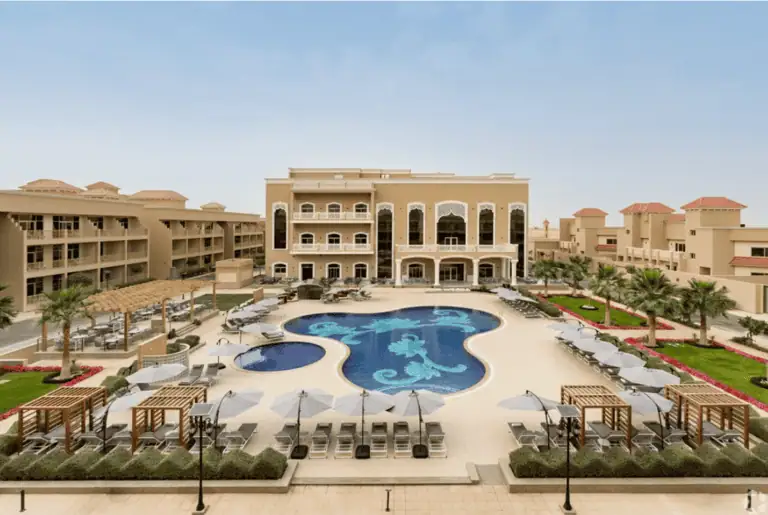
Less than three and a half years after launching its Vision 2030 tourism plan, Saudi Arabia has proposed minimum staffing requirements for hotels and other tourist accommodations.
The Ministry of Tourism outlined the proposed ratios in a paper titled “Minimum staffing requirements for tourist hospitality facilities.”
Under the proposed rules, luxury hotels and resorts would need three employees per room. Five-star hotels would require four employees for every five rooms.
The requirements would also vary by hotel category:
- Luxury hotels and resorts: three employees per room
- Five-star hotels: four employees per five rooms
- Heritage hotels: three employees per five rooms
- Four-star hotels: three employees per five rooms
- Three-star hotels: two employees per five rooms
- Two-star hotels: one employee per five rooms
- One-star hotels: one employee per 10 rooms
The proposed rules also cover serviced apartments. If approved, the staffing requirements would apply throughout the calendar year.
Proposed Rules Could Take Effect in 2027
The Saudi government has opened the proposals for public consultation. A decision is expected by the end of this year, with the rules scheduled to take effect on January 1, 2027, if ratified.
According to The Saudi Gazette, “the regulations require hospitality establishments to maintain the minimum number of employees continuously throughout the calendar year.”
Hotels that received their licenses before the regulations were announced would have 180 days to meet the requirements. Hotels moving into a higher segment would have 90 days.
Saudi authorities would begin enforcing the requirements from the first day of 2027. Penalties could also be imposed from that date.
Hotel Staffing Has Become More Complex
Philip Wooller, area director for the Middle East and Africa at STR, CoStar Group’s hospitality analytics division, said staffing calculations have become more complicated as hotels have expanded their food and beverage operations and outsourcing arrangements.
Hotel operations once involved simpler staffing models, with fewer food and beverage outlets and less outsourcing, Wooller said.
“Now, they are a lot more complex. Some hotels in the United Arab Emirates have multiple restaurants, some outsourced, some managed. The Atlantis has over 40 restaurants,” Wooller said of the 1,544-room hotel in Dubai. “With all those factors to consider, how do you draw a conclusion?”
As an example, Wooller said a hotel company managing more than 30 properties in the UAE might use a ratio of 0.5 employees per room. For luxury hotels, the figure could reach 1.5 to 1.7 employees per key.
“But again, its subjective. … Thinking back to my days [as a hotelier myself] those numbers are elevated from United Kingdom standards but not by too much, maybe 25% higher. I used to run a 442-room hotel, and I had over 200 staff. The Saudi table says I should have had 265 members of staff,” he said.
Wooller described Saudi Arabia’s proposed staffing standards as sensible. He said they could further develop and reinforce service quality.
In the Middle East, hospitality service standards are often higher, while salary costs are generally lower, Wooller said. However, he added, “the jury is slightly out on that one.”
The UAE does not currently have specific staffing ratios based on hotel class.
Saudi Hotels Prepare Local Hospitality Talent
Muin Serhan, CEO of owner, developer and management firm Amsa Hospitality, said his company has six hotels in Saudi Arabia, with another two scheduled to open soon.
Serhan said partnerships with Saudi universities, including King Khalid University, are helping bring international service standards to the kingdom.
Amsa launched the Amsa Academy in 2024 to prepare Saudi workers for hospitality roles. According to Serhan, the vocational training academy is open to future Amsa Hospitality employees as well as Saudi graduates who may later join other hotel groups.
“Partnering with local universities is key to our mission at Amsa Academy because it gets graduates into real hotels early,” he said. “Saudis already have hospitality in their DNA, that welcoming instinct is cultural. What’s needed now is training them to the level international travelers are accustomed to. That only comes from structured time on hotel floors across the kingdom, learning the standard, not just the theory.”
Miret Padovani, a Dubai-based hospitality business advisor who works extensively in Saudi Arabia, said she has met many young Saudis working in hospitality.
She noted that Saudi Arabia has one of the world’s youngest populations, with approximately 60% of Saudis under the age of 30.
“That’s a great supply of talent, but supply alone doesn’t solve a staffing gap. I believe it is the industry’s responsibility, together with the public sector, to prepare that talent for hospitality roles,” she said. “What stands out is their enthusiasm to learn, develop their skills and grow in their careers, as well as the pride they take in contributing to the future of hospitality in Saudi Arabia.”
Saudi Arabia’s Tourism Sector Continues to Grow
On June 18, the Saudi Arabian Ministry of Tourism released its latest tourism figures.
The country recorded 123 million inbound and domestic tourists in 2025, an increase of approximately 6% from the previous year.
Tourism spending reached approximately 304 billion Saudi riyals ($80 billion), representing a record 7% year-over-year increase. Tourism also accounted for 4.9% of Saudi Arabia’s gross domestic product.
Women now represent 47% of the country’s tourism workforce, according to the ministry’s report.
The report also found a change in the reasons for inbound travel.
“Non-religious purposes accounted for approximately 52% of total inbound overnight visitors’ purpose of trip in 2025, representing more than half of all inbound overnight visitors, compared to 44% in 2019,” the report added.
Related Coverage
Pet Travel Rules in India 2025: What to Know Before You Fly or Take the Train
Maldives Government Proposes SEZ Amendments to Establish Sustainable Townships
Saudi Arabia Emerges as MENA’s Fastest-Growing Travel Market, WTTC Report Shows
Saudi Launches Package Visa to Simplify Tourist Travel Bookings
Éclat Hotels Marks Entry into the Kingdom of Saudi Arabia
Editorial disclosure: This article is an independently written editorial analysis based on industry reoprting from CoStar News Hotels and insights from Terence Baker. The content has been rewritten and contextualised for editorial clarity and relevance.
