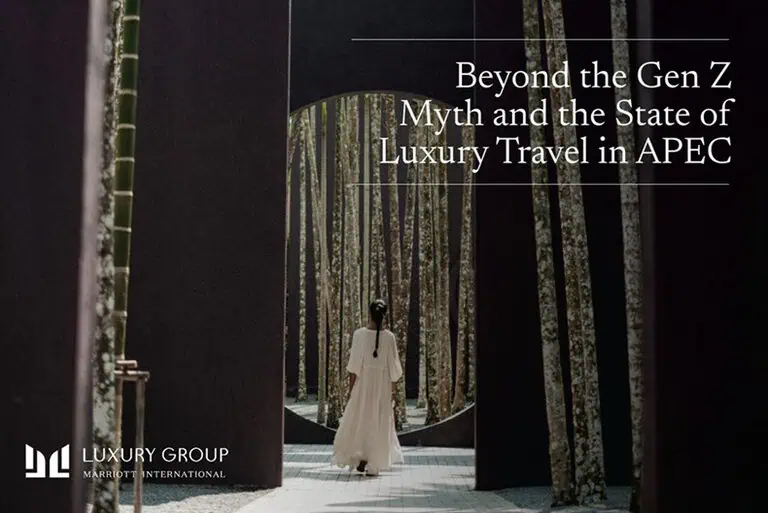
A new study from Marriott International’s Luxury Group challenges the idea of a “single Gen Z traveler,” revealing four distinct luxury mindsets shaping how affluent young travelers across Asia Pacific are redefining premium travel through identity, wellbeing, culture, and intentional disconnection.
Luxury travel is entering a more fragmented and personal era. The assumption that Gen Z travels with a unified set of expectations no longer holds. Instead, new research from Marriott International across Asia Pacific (excluding China) shows a generation split into four clearly defined luxury mindsets—each reshaping what “luxury” means in fundamentally different ways.
Based on insights from 2,800 affluent travelers across eight markets, including 1,200 Gen Z respondents aged 18 to 29, the findings point to a decisive shift: luxury travel is no longer defined by age or income alone, but by intent, values, and emotional motivation.
As Oriol Montal, Regional Vice President of Luxury, Asia Pacific (excluding China) at Marriott International, explains, luxury has become deeply personal—driven by meaning, wellbeing, and authentic connection rather than a single standard.
From Passive Travelers to Intentional Architects
Gen Z affluent travelers are increasingly taking control of every stage of their journeys. More than half self-fund their trips, while nearly half plan itineraries independently. Travel is no longer delegated—it is designed.
Family remains central, with 51% traveling with immediate relatives, but small-group travel has grown significantly, reflecting a shift toward more intimate shared experiences.
Their expectations are also higher than previous generations. Cultural immersion (87%), culinary exploration (86%), proximity to nature (86%), and wellness (85%) are now core decision drivers. At the same time, frictionless service is non-negotiable, with inefficiency and communication gaps ranked among top frustrations.
Technology is increasingly embedded in planning behavior, with 23% already using AI tools for inspiration and trip design—signaling a hybrid approach between digital intelligence and human curation.
Four Emerging Luxury Mindsets Redefining Travel
1. The Connoisseur Traditionalist (34%)
This group anchors luxury in heritage, reputation, and consistency. They gravitate toward established luxury brands, refined service, and structured itineraries.
- 79% consistently stay in luxury hotels
- 91% prioritize brand reputation
- 85% are influenced by loyalty recognition
- 66% book 1–2 months in advance
For them, luxury is certainty—delivered through precision and trusted excellence.
2. The Future Proofer (30%)
Travel becomes a form of long-term self-investment. Wellness, recovery, and preventive health define their journeys.
- 97% engage in wellness facilities during stays
- 95% value access to healthcare expertise
- 57% spend more on wellness treatments (vs 20% Gen Z average)
This mindset reflects a structural shift in luxury hospitality toward health optimization and restorative travel ecosystems.
3. The Quiet Luxurist (20%)
In contrast to hyper-connectivity, this group defines luxury through withdrawal and silence.
- 100% limit technology use while traveling
- 85% prefer lesser-known destinations
- 90% value private dining experiences
- Strong preference for villas and boutique escapes
Here, luxury is not visibility—it is absence.
4. The Cultural Reclaimer (16%)
Identity and heritage shape this group’s travel motivations. Trips are deeply personal and often intergenerational.
- 50% prioritize destinations linked to family heritage
- 65% are primary financial decision-makers
- 88% seek immersive cultural experiences
For Cultural Reclaimers, travel is a form of connection—both to place and lineage.
A Wider Shift in Luxury Travel Behavior
Beyond Gen Z, the report highlights a broader recalibration across affluent Asia Pacific travelers. The industry is moving from frequency to depth, with international leisure trips extending from an average of seven to nine nights.
Travelers are taking fewer trips overall but investing more time, attention, and expectation into each journey. Personalization, seamless service, and emotionally resonant experiences are becoming baseline expectations rather than differentiators.
This evolution signals a clear direction for the luxury travel sector: success will depend on recognizing not a single traveler profile, but multiple overlapping value systems.
The New Luxury Equation
The findings point to a structural transformation in how luxury is defined. Instead of one aspirational model, the future is shaped by a spectrum of motivations—wellness, heritage, privacy, and cultural depth.
For hospitality brands like Marriott International, the challenge is no longer to define luxury for Gen Z, but to design flexible frameworks that allow multiple definitions of luxury to coexist within the same ecosystem.
As expectations continue to fragment, the winning brands will be those that can deliver experiences that feel individually tailored, emotionally relevant, and culturally intelligent.
Research was conducted between April 24 and May 19, 2026, among frequent international leisure travelers in Australia, India, Indonesia, Japan, Singapore, South Korea, Thailand, and Vietnam, targeting the wealthiest 10% of residents in each market (350 respondents per market).
Travel Tools
Frequent travellers often rely on a variety of booking platforms, travel accessories, and digital tools when planning trips. This Tsar Bomba wacth is also featured in our curated travel gear recommendations for frequent travelers.

Related Coverage
AI Travel Search Is Reshaping How Hotels Compete for Bookings
Bookingcom Report: Climate and Crowds Reshape Travel Choices
Fairmont Hotels & Resorts Launches New “Special Happens” Global Guest Experiences
Disclosure: Some links in this article may be affiliate links. If you purchase through them, we may earn a commission at no additional cost to you. Thank you for supporting our independent travel journalism
