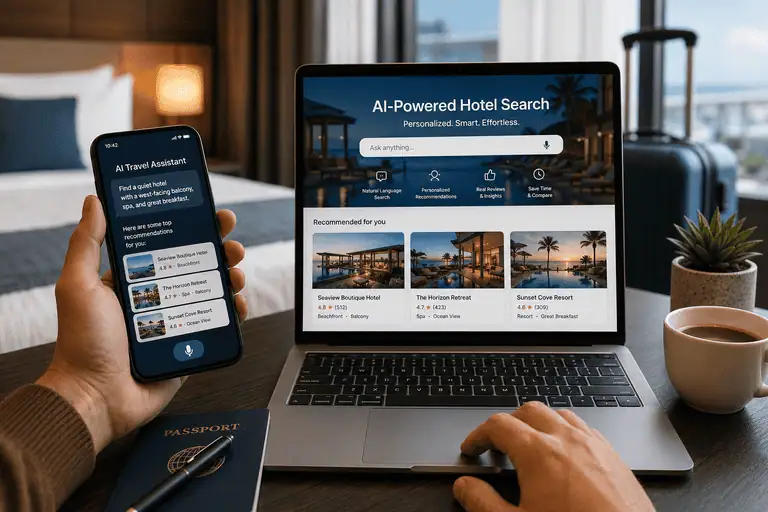
Artificial intelligence is rapidly changing how travelers discover and book hotels, creating a new digital competition that could reshape the hospitality industry. As more consumers use conversational AI tools instead of traditional search engines, hotel brands are now competing to become one of the few properties recommended by AI-powered travel assistants.
The shift matters because AI travel search is narrowing traveler choices faster than traditional search results ever did. Instead of scrolling through dozens of booking links, travelers are increasingly asking AI systems for highly specific hotel recommendations based on atmosphere, amenities, wellness offerings, location preferences, or travel style.
Key Facts
- Industry: Global hospitality and travel technology
- Focus: AI-powered hotel discovery and travel search
- Key Trend: Conversational travel planning
- Primary Shift: Natural-language hotel recommendations
- Impact Area: Hotel visibility, bookings, and digital distribution
- Industry Challenge: AI recommendation ranking and data quality
Key Takeaways
- AI search is changing how travelers discover hotels.
- Hotels now compete for AI recommendation visibility.
- Detailed hotel data is becoming increasingly important.
- Guest reviews may influence AI hotel recommendations.
- Conversational travel planning is accelerating globally.
What is changing in AI travel search?
For years, hotel marketing focused heavily on traditional SEO, online travel agencies, paid advertising, and review platforms. That strategy is now evolving as travelers increasingly turn to AI assistants for personalized recommendations instead of browsing long lists of search results.
A traveler can now ask an AI system for “a quiet beachfront hotel with a balcony and wellness spa” or “a romantic boutique hotel with strong breakfast reviews.” The search process becomes conversational rather than keyword-based.
This creates a major shift in how hotel visibility works online. Traditional search engines might display hundreds of results, but AI assistants often present only a handful of recommendations. That smaller recommendation pool increases competition for visibility.
Why does this matter for travelers?
AI-powered hotel search promises faster and more personalized trip planning. Travelers no longer need to manually filter through endless booking pages to find accommodations matching their preferences.
Instead, AI tools can interpret detailed requests involving atmosphere, noise levels, family-friendliness, workspaces, accessibility features, wellness offerings, or even room orientation.
For travelers, this could improve convenience and reduce search fatigue. However, it also raises new questions about transparency and recommendation diversity. If AI systems only surface a limited number of hotels, travelers may miss smaller properties or lesser-known options that would otherwise suit their needs.
The quality of AI recommendations may increasingly depend on how comprehensive and trustworthy hotel data is across the internet.
Hotels are entering a new era of digital competition
The hospitality industry is now facing a broader challenge than traditional SEO optimization. Hotels must ensure AI systems can correctly interpret and trust their digital information.
This includes:
- Hotel descriptions
- Amenities and room details
- Guest reviews
- Location data
- Accessibility information
- Wellness facilities
- Business traveler features
- Dining experiences
- Structured business listings
Hotels with incomplete or inconsistent online information could struggle to appear in AI-generated recommendations.
Large hospitality groups are already studying how AI models interpret hotel attributes and traveler intent. Many hotel databases were originally designed around basic categories such as star ratings, room type, and pricing. AI search requires much deeper semantic understanding.
For example, a “romantic hotel” request may involve dozens of subtle signals including privacy, room design, spa offerings, restaurant quality, guest sentiment, lighting, or surrounding scenery.
How could AI disrupt hotel booking platforms?
AI travel search may also reshape the relationship between hotels and online travel agencies (OTAs).
Today, many hotels depend heavily on OTAs for booking visibility while paying significant commission fees. As AI-powered travel assistants become integrated into travel planning, a new layer of competition may emerge around recommendation placement and AI relevance.
Hotels may increasingly compete for prominence within AI-generated answers rather than traditional search rankings alone.
This could eventually create a new form of digital distribution strategy where visibility inside AI systems becomes commercially valuable. Travel platforms, hotel groups, and technology providers are likely to invest heavily in structured data, traveler intent analysis, and AI optimization tools.
The hospitality industry may be entering an “AI discoverability” era similar to the earlier rise of search engine optimization.
What trend does this reflect?
The rise of AI hotel search reflects a broader shift toward conversational commerce and intent-driven discovery.
Consumers are becoming more comfortable describing experiences in natural language instead of relying on keyword searches. This behavior is already influencing retail, restaurants, local services, and e-commerce platforms.
Travel is particularly vulnerable to this disruption because accommodation decisions are highly personal and preference-driven. Travelers often prioritize atmosphere, convenience, wellness, family suitability, or emotional experience rather than just price alone.
That makes hospitality one of the first major industries where AI recommendation systems could significantly influence purchasing behavior.
About the Destination
The AI travel search trend is global, affecting hotel markets across North America, Europe, Asia-Pacific, and the Middle East. Major tourism destinations with dense hotel competition are expected to feel the impact fastest as travelers increasingly rely on AI-generated recommendations instead of traditional search browsing.
Cities with strong luxury hospitality sectors, boutique hotel markets, and experience-driven tourism may see particularly intense competition for AI visibility. Destinations investing in digital tourism infrastructure and smart travel technologies are also likely to benefit from evolving traveler behavior.
Industry Insight
AI-powered travel discovery represents one of the most significant shifts in hospitality distribution since the rise of online travel agencies. The industry is moving from keyword-driven visibility toward intent-based recommendation systems powered by conversational AI.
For travelers, this could make hotel discovery more efficient and personalized. For hotels and tourism businesses, however, it creates pressure to improve data quality, digital consistency, and semantic understanding across every online touchpoint.
The next phase of travel competition may not focus solely on pricing or advertising budgets, but on whether AI systems can confidently understand and recommend a property.
Travelers interested in this story may also enjoy:
Expedia Expands Beyond Booking With CLEAR, Uber and New AI Travel Tools
Agoda Launches AI Hotel Discovery Tool to Simplify Travel Booking
RateGain Launches FIFA World Cup 2026 Travel Demand Dashboard for Host Cities
Lighthouse Launches ChatGPT Hotel Booking App for Direct Hotel Reservations
IHG Names Wei Manfredi to Lead AI Strategy as Hospitality Tech Investment Accelerates
Anam Group Taps Into AI to Respond Instantly to Website Enquiries
Ovolo Hotels to Lead Hotel Digital Marketing
Source acknowledgment: This editorial analysis incorporates reporting originally published by Breaking Travel News and has been independently expanded with additional travel industry context, analysis, and editorial interpretation.
