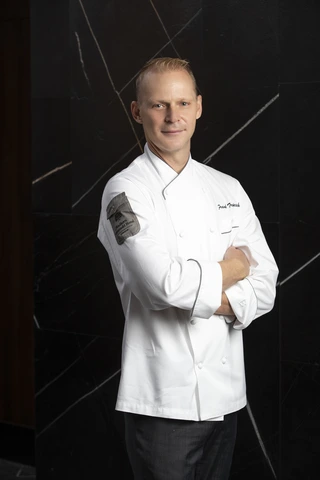
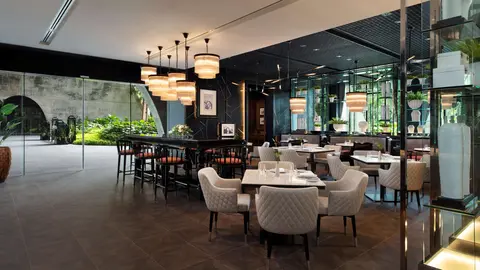
During my stay at Sindhorn Kempinski Hotel Bangkok last month, I had dinner at Flourish, the hotel’s all-day dining restaurant. The meal was exceptional—so much so that I asked if I could meet the chef behind it.
A short while later, Executive Chef Frank Trepesch came out to greet me. After exchanging a few pleasantries, I asked if he would be open to an interview for Red Bird Travel News. To my delight, he graciously accepted.
What followed was a candid conversation about his culinary journey, leadership philosophy, sustainability, and where he believes hotel dining is headed. Here is our interview.
In Conversation with Executive Chef Frank Trepesch
1. What is your role at Sindhorn Kempinski Hotel Bangkok, and what does a typical day look like?
I am the Executive Chef. I start early each morning by checking the breakfast operation and inspecting all the chillers.
No two days are ever the same. It’s a fast-paced environment that involves checking the restaurants, coordinating events, preparing food tastings for clients, developing new menu dishes, meeting suppliers, planning future events, and attending internal meetings.
2. Tell us about your culinary journey. What first inspired you to become a chef?
My first inspiration was my cousin and her husband. They are both chefs. When I was young, they cooked at our home for occasions such as Christmas, Easter and birthdays.
I was always helping in the kitchen, and by the age of six I already knew I wanted to become a chef.
3. Who has been the biggest influence on your career?
There have been several major influences throughout my career. Early on, I worked in several Michelin-starred restaurants, and every chef I worked with had an impact on me.
The biggest culinary influence was Christian Scharrer, a two-Michelin-star chef from Germany. I worked alongside him for eight years as his sous chef.
Later, the management team at The Savoy in London encouraged and supported me to go out and see the world.
4. Looking back, what has been the biggest turning point in your career?
When I decided to leave Germany.
5. How would you describe your cooking philosophy?
Source the best ingredients, treat them with respect, and remember that sometimes less is more.
6. How would you describe your personal culinary style?
Classic.
7. Is there a signature dish that best represents you? Why?
I never liked this question because I never really had a signature dish. One day, I created salmon on caramelised sauerkraut with apple potato nage and ikura caviar for an event.
People looked at the menu with some scepticism, but after the event around 90% of the guests praised the dish.
After that, I decided to make it my signature dish, and I’ve since served it at several events.
8. Where do you find inspiration for new dishes?
Nowadays, inspiration is everywhere, especially on social media. That doesn’t mean copying ideas, but rather finding inspiration.
Sometimes I simply try combinations that sound unusual, like the salmon dish I mentioned.
9. How do you balance creativity with consistency across your menus?
You simply need to stay on top of every detail.
10. What role do locally sourced ingredients play in your menus?
They play a big role. Apart from certain fish and meats that aren’t available in Thailand, we source almost everything locally.
11. How do you balance local produce with premium imported ingredients?
The quality of local produce, especially fruits and vegetables, is often better than imported products because there is no lengthy transportation. Today, you can source almost everything locally.
12. Sustainability has become increasingly important. How does it influence the way you run your kitchen?
Sustainability is an important part of how I run a kitchen because it’s good for the environment and also improves efficiency and profitability.
I focus on reducing food waste through careful ordering, proper storage, and using ingredients creatively across different dishes. I work closely with suppliers to source seasonal and local products whenever possible, ensuring freshness while reducing transportation impacts. I also encourage my team to be mindful of energy and water use.
In a five-star hotel, guests now expect sustainable practices without compromising quality. I believe it’s our responsibility, and I make sustainability part of the kitchen culture by involving the whole team.
13. Food costs continue to rise. How do you maintain quality while managing budgets?
A good approach is to centralise production for items such as stocks, jus, soups and dressings. This ensures consistency across multiple outlets. It’s also important to monitor costs closely, purchase seasonal products, and minimise food waste.
14. What qualities do you look for when hiring new chefs?
Attitude.
15. How would your team describe your leadership style?
Straightforward but fair.
16. What’s the biggest lesson you’ve learned about leading a kitchen?
A kitchen team is like a football team. You might score a goal on your own, or even win a match, but you only win the season if you have a great team.
17. Can you share a success story of someone you’ve mentored?
In my first position as Chef de Partie, I mentored an apprentice who followed my guidance and later worked in several of the same kitchens I had worked in. We even worked together again when I became Chef de Cuisine.
Today, he has maintained two Michelin stars for 11 consecutive years.
18. What do you think are the biggest challenges facing hotel kitchens today?
Attracting and encouraging young talent. Many young people today are looking for careers that offer an easier way to earn a living, so bringing them into professional kitchens has become increasingly challenging.
19. What role does technology play in your kitchen today?
Technology plays a major role. Almost everything is becoming AI-assisted or computer-controlled, except for the actual cooking and tasting.
20. How do you accommodate dietary requirements and special requests without compromising the dining experience?
Today there’s something for everyone, regardless of dietary preference or allergy. If you have strong fundamental cooking skills and techniques, you can accommodate almost any request without compromising the dining experience.
21. What has been your proudest achievement as a chef?
I have been proud of every step I’ve taken throughout my career and where I stand today.
22. If you could cook with any chef, past or present, who would it be and why?
Anthony Bourdain, because he respected ingredients, loved cooking, and understood that sharing a meal with people and enjoying a good conversation is one of life’s greatest luxuries.
23. Which destination has had the greatest influence on your cooking?
The Colombi Hotel in Freiburg, Germany, because it was a large-scale luxury operation that consistently maintained a Michelin star for decades.
Its former chef, Alfred Klinck, was highly respected, even by many three-Michelin-star chefs of his time.
24. What local dish do you think every visitor should try?
Pad Kra Pao.
25. Where do you see the future of hotel dining over the next five years?
In holiday destinations and resorts, I don’t think much will change, except that guests will become more demanding and place even greater emphasis on sustainability.
In cities, however, I believe hotels will increasingly focus on breakfast and events, while guests choose to dine outside the hotel for lunch and dinner because the dining options are so extensive. The exception is hotels with restaurants that have a concept everyone is talking about.
26. What advice would you give aspiring chefs entering the hospitality industry today?
Be patient and stay hungry to learn. Take one step at a time because knowledge and experience are essential to becoming a good chef.
27. If guests remember just one thing after dining at your restaurant, what would you like it to be?
That they felt welcome and genuinely cared for. That’s what brings guests back. And, of course, that they enjoyed a great meal.
To finish our conversation on a lighter note, I put Chef Frank through a quick rapid-fire round of questions. Here’s how he responded.
Rapid-fire with Chef Frank
Sweet or savoury?
Savoury.
Coffee or tea?
Tea.
Breakfast, lunch or dinner?
Dinner.
One ingredient you can’t live without?
Mustard.
One ingredient you dislike cooking with?
Sorrel.
Favourite comfort food?
Currywurst.
Your go-to midnight snack?
Flavoured almonds.
A destination every foodie should visit?
Bangkok.
Three words that describe your cooking.
Clean. Honest. Tasty.
Finish this sentence: “Great food is…”
Art.
Related Coverage
Sindhorn Kempinski Hotel Bangkok Welcomes Back Thaddaeus to Lead Next Growth Phase
