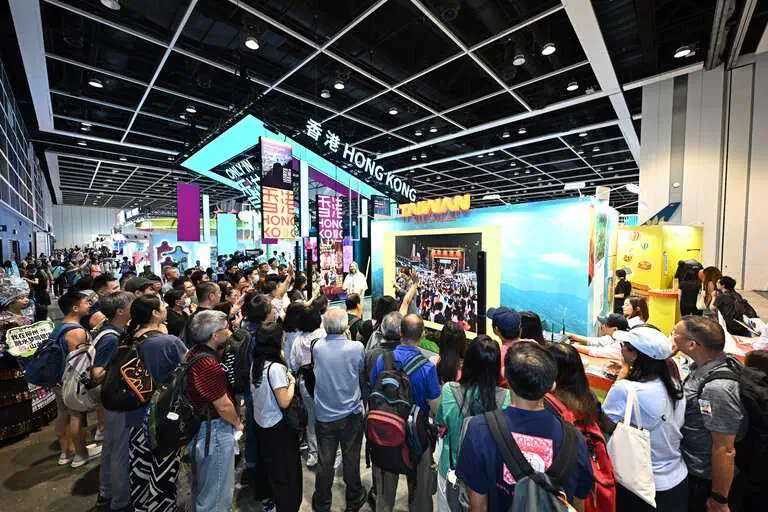
More than 90% of respondents to the ITE Hong Kong Public Visitor Survey 2026 said they would maintain or increase their travel spending, despite geopolitical uncertainty. The findings suggest that travel budgets among surveyed visitors have remained broadly stable compared with 2025.
Conducted in June 2026, the survey received 2,687 responses. It found that many respondents were frequent outbound travellers, with a preference for independent travel or private tours. Most were aged 25 to 59, and more than half held a university degree.
The survey also found that nearly half of respondents were interested in booking holidays at the exhibition. Many used their own mobile devices to complete online transactions.
Comparisons with surveys conducted in June 2025 and March 2026 offer insights into how geopolitical developments may be affecting travel frequency, spending and destination preferences.
ITE Hong Kong 2026: Survey Background and Exhibition Figures
The ITE Hong Kong Public Visitor Survey has been conducted online annually around June for nearly two decades. The 2026 survey also sent electronic invitations to previous exhibition visitors and collected 2,687 responses.
ITE Hong Kong celebrated its 40th anniversary in 2026. According to the organiser, the exhibition attracted more than 600 international exhibitors, 8,442 buyers and trade visitors, and 74,170 public visitors.
More than 90% of the buyers and trade visitors came from outside Hong Kong, while over half of the exhibitors were also based overseas. The organiser described most public visitors as quality independent travellers.
The exhibition featured around 130 seminars for trade and public audiences, attracting more than 8,500 attendees.
The next edition, ITE Hong Kong 2027, will incorporate the 41st International Travel (Leisure) Expo and the 22nd MICE Travel Expo. It is scheduled for June 10–13, 2027, at the Hong Kong Convention and Exhibition Centre (HKCEC), Hall 3.
The four-day event will allocate two days to trade visitors and two days to the public, with separate business-to-business (B2B) and business-to-consumer (B2C) programmes.
1. Greater Bay Area and Hong Kong Remain Important Source Markets
China’s Greater Bay Area (GBA), which includes Hong Kong, Shenzhen, Guangzhou and other cities in Guangdong, accounts for two-thirds of ITE’s trade buyers and more than 90% of its public visitors, according to the organiser.
In 2025, the GBA had a combined population of 88 million and a gross domestic product (GDP) of approximately US$2.15 trillion. That economic output would have ranked the region as the world’s 10th-largest economy.
Hong Kong also represents a significant outbound travel market. With a population of 7.5 million in 2025, the city ranked 15th globally in outbound tourism spending, according to the World Tourism Barometer published in May 2026.
The same source reported Hong Kong’s outbound spending at US$30.3 billion in 2025. On a per-capita basis, that equated to US$4,040, compared with US$1,568 in Germany and US$692 in South Korea.
Hong Kong: Departures and Outbound Spending
| Year | Departures (million) | Outbound spending (US$ billion) |
|---|---|---|
| 2019 | 94.7 | $26.9 |
| 2023 | 72.2 | $22.7 |
| 2024 | 104.7 | $28.9 |
| 2025 | 117.4 | $30.3 |
Outbound Spending Per Capita by Market
| Market | Global spending rank | Outbound spending | Population | Spending per capita |
|---|---|---|---|---|
| Hong Kong | 15th | US$30.3 billion | 7.5 million | US$4,040 |
| South Korea | 11th | US$35.7 billion | 51.6 million | US$692 |
| Germany | 3rd | US$130.9 billion | 83.5 million | US$1,568 |
Source: World Tourism Barometer, May 2026.
2. Most Survey Respondents Are of Working Age and Educated
The survey found that 79% of ITE public visitors were aged 25 to 59, compared with 51% of Hong Kong’s overall resident population. In addition, 51.9% of respondents held a university degree, compared with 24.5% of Hong Kong residents.
These figures indicate that the exhibition’s surveyed audience had a higher proportion of working-age adults and university graduates than the general population.
Age Profile: ITE Visitors vs Hong Kong Residents
| Age group | ITE public visitors | Hong Kong residents |
|---|---|---|
| 25–39 | 32.0% | 19.6% |
| 40–59 | 47.0% | 31.4% |
| 60 or above | 16.0% | 31.0% |
| 25–59 combined | 79.0% | 51.0% |
Education Profile
| Education level | ITE public visitors | Hong Kong residents |
|---|---|---|
| University degree | 51.9% | 24.5% |
| Post-secondary education | 26.2% | 10.1% |
Gender Profile
| Gender | ITE public visitors | Hong Kong residents |
|---|---|---|
| Female | 63.3% | 54.7% |
| Male | 36.7% | 45.3% |
Note: Hong Kong figures refer to the overall resident population. Figures are reproduced from the survey material.
3. Independent Travel and Private Tours Are Preferred
Independent travel (FIT) and private tours were more popular than package tours among respondents, particularly for short-haul trips.
For long-haul travel lasting six days or more, 69% preferred FIT or private tours, compared with 31% who preferred package tours. For short-haul travel, the respective figures were 85.9% and 14.1%.
The organiser noted that the introduction of travel themes such as family travel in recent years had increased interest in package tours.
Travel Mode Preferences
| Travel mode | Long-haul | Short-haul |
|---|---|---|
| Private tour / FIT | 69.0% | 85.9% |
| Package tour | 31.0% | 14.1% |
4. Travel Frequency and Budgets Remain Broadly Stable
More than 40% of respondents reported taking three or more overnight outbound leisure trips in each six-month period covered by the survey comparisons.
For January to June, the proportion taking three or more trips fell from 48.2% in 2025 to 45.5% in 2026, a decline of 2.7 percentage points. For July to December, the corresponding figure decreased from 42.8% to 41.8%, down one percentage point.
The survey organiser interpreted these relatively small changes as evidence that geopolitical developments had limited effects on the travel frequency of its respondents.
Frequency of Overnight Outbound Leisure Trips
| Number of trips | Jan–Jun 2025 | Jan–Jun 2026 | Jul–Dec 2025 | Jul–Dec 2026 |
|---|---|---|---|---|
| 3 or more trips | 48.2% | 45.5% | 42.8% | 41.8% |
| 1–2 trips | 45.7% | 49.0% | 54.5% | 55.4% |
| 0 trips | 6.1% | 5.5% | 2.7% | 2.8% |
Note: The July–December 2026 figures are presented as reported in the survey material.
Travel budgets showed a similar pattern. The proportion planning to increase spending edged down from 39.3% in 2025 to 38.4% in 2026. Meanwhile, the share expecting to maintain the same budget rose from 51.5% to 52.7%.
Only 8.9% expected to reduce spending in 2026, compared with 9.2% in 2025. Overall, 91.1% planned to maintain or increase their travel budgets.
Travel Spending Plans: 2025 vs 2026
| Spending plan | 2025 | 2026 |
|---|---|---|
| Increase | 39.3% | 38.4% |
| Same as last year | 51.5% | 52.7% |
| Decrease | 9.2% | 8.9% |
The figures suggest that geopolitical uncertainty had not substantially changed the travel budgets of the surveyed visitors. However, the findings describe respondents’ reported spending plans and do not necessarily represent the behaviour of all travellers in Hong Kong.
5. Exhibition Visitors Show Interest in Destination Discovery and Onsite Bookings
The survey’s five leading reasons for visiting ITE point to opportunities for tourism boards, travel suppliers and exhibitors to engage directly with potential customers.
Collecting international travel information from exhibitors ranked first, cited by 74.9% of respondents. Discovering new and niche destinations came second, at 49.3%.
Nearly half, or 45.9%, expressed interest in booking holidays and travel products onsite. Other reasons included visiting photo booths, cultural performances and games, and attending travel seminars.
Top Reasons for Visiting ITE
| Reason | Respondents |
|---|---|
| Collect international travel information directly from exhibitors | 74.9% |
| Identify new and niche destinations | 49.3% |
| Book holidays and travel products onsite | 45.9% |
| Visit photo booths, cultural performances and games | 31.1% |
| Attend travel seminars | 30.0% |
The organiser noted that around one-third of visitors planned to attend seminars, which it viewed as an indication of their engagement with travel-related information. The finding that 45.9% were interested in onsite bookings also points to potential sales opportunities.
Visitors often use their own mobile devices to complete online transactions. As a result, exhibitors from outside Hong Kong may consider working with local partners to sell travel products to visitors.
Companies planning to sell directly in Hong Kong should independently review the relevant local laws and regulations. The organiser’s source material refers to examples of potentially relevant Hong Kong legal provisions, but does not reproduce the links in the supplied text. Exhibitors should therefore conduct their own legal research before proceeding.
6. Survey Points to Weaker Interest in Destinations Outside Asia
The survey recorded changes in respondents’ preferred outbound holiday destinations between 2025 and 2026. The largest declines occurred in the category covering destinations outside Asia.
For January to June, the share selecting destinations outside Asia fell from 14% in 2025 to 11.7% in 2026, a relative decline of 16.4%. Over the same period, West and Central Asia was the only listed regional category to record growth, rising from 2% to 2.6%.
For July to December, the share selecting destinations outside Asia fell from 32% to 22.6%, a relative decline of 29.4%. The other regional categories either remained broadly stable or recorded increases.
The organiser linked these results to geopolitical developments and cited its March 2026 survey, in which 72% of respondents said they avoided areas affected by geopolitical developments. In that earlier survey, 86.5% also agreed that air ticket prices affected their travel plans.
These findings suggest that geopolitical uncertainty and airfare costs may be influencing destination choices. However, the survey figures alone do not establish the precise cause of the changes.
Outbound Holiday Destination Preferences
| Destination | Jan–Jun 2025 | Jan–Jun 2026 | Jul–Dec 2025 | Jul–Dec 2026 |
|---|---|---|---|---|
| Chinese mainland, Macau and Taiwan | 70.0% | 70.5% | 57.0% | 57.4% |
| Northeast Asia (Japan and South Korea) | 53.0% | 50.9% | 57.0% | 63.6% |
| Southeast Asia | 19.0% | 16.6% | 27.0% | 26.6% |
| West and Central Asia | 2.0% | 2.6% | 5.0% | 5.9% |
| Outside Asia | 14.0% | 11.7% | 32.0% | 22.6% |
Preferences for Destinations Outside Asia
The survey also divided destinations outside Asia into three groups: North America and Europe; Latin America, Africa and the Middle East; and Oceania.
All three categories recorded lower shares in the 2026 comparisons. For January to June, North America and Europe fell from 8% to 6.7%, while Latin America, Africa and the Middle East declined from 2% to 1.7%. Oceania decreased from 4% to 3.3%.
For July to December, North America and Europe dropped from 17% to 12.9%. Latin America, Africa and the Middle East fell from 4% to 2.9%, while Oceania declined from 11% to 6.8%.
Non-Asian Destination Preferences
| Destination | Jan–Jun 2025 | Jan–Jun 2026 | Jul–Dec 2025 | Jul–Dec 2026 |
|---|---|---|---|---|
| North America and Europe | 8.0% | 6.7% | 17.0% | 12.9% |
| Latin America, Africa and the Middle East | 2.0% | 1.7% | 4.0% | 2.9% |
| Oceania | 4.0% | 3.3% | 11.0% | 6.8% |
Note: Destination preferences are reproduced from the supplied survey material. The source does not specify whether respondents could select multiple destinations.
ITE Hong Kong 2027: Dates and Organiser Support
ITE Hong Kong is organised by TKS Exhibition Services Ltd. The organiser reports receiving support from government bodies and tourism industry organisations.
ITE 2026 received a welcome message from the Chief Executive of the Hong Kong SAR Government. China’s Ministry of Culture and Tourism also organised a China (Chinese Mainland) Pavilion, with participants from dozens of provinces and municipalities and hundreds of co-exhibitors from the mainland.
Other supporting organisations include the Hong Kong Tourism Board and the Travel Industry Council of Hong Kong.
ITE Hong Kong 2027, incorporating the 41st International Travel (Leisure) Expo and the 22nd MICE Travel Expo, is scheduled for June 10–13, 2027, at HKCEC, Hall 3. The programme will include separate trade and public days, alongside B2B and B2C activities.
More Information and Media Enquiries
For further information about ITE Hong Kong, visit www.itehk.com.
For exhibition participation and media enquiries, contact the organiser, TKS Exhibition Services Ltd.
- Email: travel@tkshk.com
- WhatsApp: +852 9400 8444
- WeChat: itehongkong
- Facebook: itehk
Related Coverage
What Today’s Luxury Travelers Value Most
ITE Hong Kong 2026 Expands with Ice Travel and Global Exhibitors
Madame Tussauds Hong Kong Debuts K-drama Heartthrob Ahn Hyo Seop’s Wax Figure
